Thursday, April 30, 2009
Some light relief...
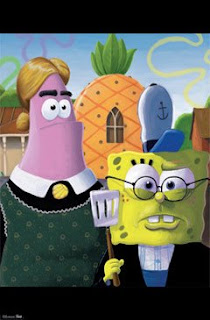
American Gothic 2 - Patrick and SpongeBob
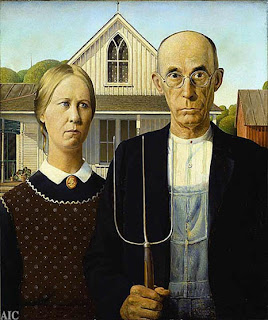
As much as i d like SpongeBob I think that Squidward would have been a more suitable substatute for the man in this take on American Gothic. The creator seems to have missed that in the original the pitchfork (here the spatula) is reflected within the man's dungarees (don't know how to spell that sorry!) and in the window behind. An effort for the idea of '3' has been made within Bob's shirt but this is not as effective as the original. However this image and the idea of creating it is very much in the style of the wonderful people to do SpongeBob...Wednesday, April 29, 2009
Museums at Night
American Gothic

Monday, April 27, 2009
CFP: Old Collectables in a Modern World (Ghent, ESSHC, 13-16 Apr 10)
Session: Old Collectables in a Modern World.
The Consumption and Circulation of Art and Antiques in European Cities, ca. 1750 - ca. 1914
European Social Science History Conference
13-16 April 2010
Ghent, Belgium at the Bijloke Site
From at least the middle of the eighteenth century onwards, European citizens showed an altering attitude towards old and used objects. The dawn of the much-discussed consumer and industrial 'revolutions' gave way to a material culture dominated by convenience, hygiene and fashion. Age-old consumer practices centered on second-hand circulations and the re-use of family/ household possessions began to wane in favor of a continual renewal of the urban home. The rise of this modern 'neophiliac' behavior is more or less known - tied to well studied processes such as industrialization, urbanization, changes in population growth and transport. Colin Campbell in particular linked these emerging attitudes to a nascent 'romantic' culture. Symptomatic of elusive feelings of loss and incompleteness, an uninterrupted 'hedonistic' consumption of 'newness' and 'novelty' provided a sort of existential satisfaction; materialism became a new way of life.
Ironically, the present consumption debate has largely ignored the Janus-head of the new: namely a consumption desire for the 'old', for traditions, an alliance with the past, a search for authenticity. These values were as much part of a 'romantic- sentimental' body of thought as a 'cry for the new'; and they were even becoming more important in times of structural landslides in the late eighteenth and nineteenth centuries. Thus, it is no coincidence that the second-hand markets in this period became increasingly segmented. At the one hand, old and used belongings became perceived as inferior, and, in general, harder to recycle because of fashion changes, and the lighter, more breakable and less durable nature of the product-market. However, in the growing mass of easily discarded household possessions, several product categories were dealt with growing respect and passion. A blossoming group of excited collectors and 'connoisseurs' sought out second-hand books, art or period piece furniture precisely because of its age and 'patina'. Catering for this new demand for old collectables, a set of specialized commercial circuits arose. Especially newly equipped auction rooms and professional antique shops stood at the centre of this quickly developing antiquarian culture.
This session seeks to explore the changing consumption and distribution practices connected to the circulation of arts and antiques in the course of the eighteenth and nineteenth centuries. The organizers welcome papers that address different aspects of the creation of a specific antiquarian consumer culture. New theoretical or empirical research on qualitative and/or quantitative datasets is recommended, using a methodological framework from economical, sociological, anthropological, cultural and/or historical studies. This session aims to introduce new research and approaches to a broader audience. We welcome papers on topics as diverse as:
- The rise of a specialized art & antiquarian market, both via public auctions, antique shops and through specific fairs and markets.
- The geography of selling antiques, both macro (intercity relations) and micro (intra)
- The professionalization of related occupations (auctioneers, antiquarians, experts,...)
- The nature of the buying public (social-economic background, motivations, ...)
- The lay-out of professional and private networks in antique dealing and buying
- The perception of the collectables for sale (books, art, furniture, shells, stamps, ...)
- The role of commercial prints (advertisements, auction catalogues, ...)
- The development of a wider antiquarian culture in literature, salons, ...)
Organisers: Ilja Van Damme, University of Antwerp (ilya.vandamme@ua.ac.be) and Dries Lyna, University of Antwerp (dries.lyna@ua.ac.be).
If you want to propose a paper for this session, please contact the organizers to check whether your paper would fit in this session.
Please submit your paper proposal via the conference website (http://www2.iisg.nl/esshc/register.asp) before the deadline of 1 May 2009.
____________________________________________________________________
H-ARTHIST
Humanities-Net Discussion List for Art History E-Mail-Liste fuer
Kunstgeschichte im H-Net
Editorial Board Contact Address / Fragen an die Redaktion:
hah-redaktion@h-net.msu.edu
Submit contributions to / Beitraege bitte an:
h-arthist@h-net.msu.edu
Homepage: http://www.arthist.net
____________________________________________________________________
Sunday, April 26, 2009
Reflections on writing-up #13
Friday, April 24, 2009
I might regret posting this...
More Museum Poetry
Louis Macneice
Under the hive-like dome the stooping haunted readers
Go up and down the alleys, tap the cells of knowledge --
Honey and wax, the accumulation of years --
Some on commission, some for the love of learning,
Some because they have nothing better to do
Or because they hope these walls of books will deaden
The drumming of the demon in their ears.
Cranks, hacks, poverty-stricken scholars,
In pince-nez, period hats or romantic beards
And cherishing their hobby or their doom
Some are too much alive and some are asleep
Hanging like bats in a world of inverted values,
Folded up in themselves in a world which is safe and silent:
This is the British Museum Reading Room.
Out on the steps in the sun the pigeons are courting,
Puffing their ruffs and sweeping their tails or taking
A sun-bath at their ease
And under the totem poles -- the ancient terror --
Between the enormous fluted Ionic columns
There seeps from heavily jowled or hawk-like foreign faces
The guttural sorrow of the refugees.
(Dark tourism of sorts, as the Reading Room has since moved, and one cannot re-enact Marx's visits, for example. Not that I would ever want to do such a thing... *looks around shiftily*)
Thursday, April 23, 2009
Seminar on surrealism in Copenhagen
Wednesday, April 22, 2009
Symposium: Exploding Objects
[via Material Worlds]
Exploding Objects: A New Scholars Symposium is a one day event being held by
Goldsmiths Department of Sociology on 10th September 2009.
The aim of this year's symposium is to explore the status of 'objects' within current sociological debates. From tracing various objects through their journeys across social worlds to reflections on the role of the senses in constituting the perception of objects and considerations of people as 'objects' vs. 'subjects', the conference intends to 'explode' sociological understanding of 'objects' and to develop further connections across the postgraduate community.
Papers will be organised into small streams which will enable participants to present their work in a format that will encourage dialogue and constructive engagement. Each participant will be assigned one paper prior to the symposium to which s/he will be encouraged to prepare a response.
The symposium will also attempt to engage with objects in more innovative ways through a 'show and tell' workshop.
With Beverley Skeggs 'Turning it on is a class act: immediated object relations with television' and Caroline Knowles 'The life-worlds and journeys of a flip-flop sandal'.
All abstracts welcome, submission deadline 15th May 2009.
Please send to exploding@gold.ac.uk
For more information see:
And continuing the Dark Tourism theme
National Poetry Month
On the Tombs in Westminster Abbey
Francis Beaumont
Mortality, behold and fear,
What a change of flesh is here!
Think how many royal bones
Sleep within this heap of stones,
Hence removed from beds of ease,
Dainty fare, and what might please,
Fretted roofs, and costly shows,
To a roof that flats the nose:
Which proclaims all flesh is grass;
How the world's fair glories pass;
That there is no trust in health,
In youth, in age, in greatness, wealth;
For if such could have reprieved
Those had been immortal lived.
Know from this the world's a snare,
How that greatness is but care,
How all pleasures are but pain,
And how short they do remain:
For here they lie had realms and lands,
Who now want strength to stir their hands:
Where from their pulpits seal'd with dust
They preach, 'In greatness is no trust.'
Here's an acre sown indeed
With the richest, royall'st seed
That the earth did e'er suck in
Since the first man died for sin:
Here the bones of birth have cried,
'Though gods they were, as men they died.'
Here are sands (ignoble things)
Dropt from the ruin'd sides of kings;
With whom the poor man's earth being shown
The difference is not easily known.
Here's a world of pomp and state,
Forgotten, dead, disconsolate;
Think, then, this scythe that mows down kings
Exempts no meaner mortal things.
Then bid the wanton lady tread
Amid these mazes of the dead;
And these truly understood
More shall cool and quench the blood
Than her many sports aday,
And her nightly wanton play.
Bid her paint till day of doom,
To this favour she must come.
Bid the merchant gather wealth,
The usurer exact by stealth,
The proud man beat it from his thought,
Yet to this shape all must be brought.
Opportunity: Dark Tourism Research
Would you like an opportunity to receive a DVD of the TV documentary 'Turning Points of History: Dark Tourism'? Are you 16 years or older? Have you visited one or more of the following sites within the past five years?
*Auschwitz-Birkenau Memorial & Museum, Oswiecim, Poland
*Tribute WTC Visitor Centre (Ground Zero), New York, USA
*Gunter von Hagens' Body Worlds: The Original Exhibition of Real Human Bodies, Worldwide
*The Dungeon Visitor Attractions (either in London, York, Edinburgh, Amsterdam, Hamburg)
As part of a new Research Project at the University of Central Lancashire, UK, you are invited to complete our survey for a new book. 'Consuming Dark Tourism in Contemporary Society' will explore potential relationships between death and mortality and dark tourism. Your views and opinions are vital to this exciting new research. As a token of our gratitude for your participation in this research, we are offering you a Prize Draw opportunity to receive a DVD copy of the 1 hour film documentary 'Dark Tourism'. Please follow the links below to access the relevant survey(s) and to enter our Prize Draw:
Auschwitz-Birkenau Survey: http://www.survey.bris.ac.uk/uclan/auschwitz
Ground Zero Survey: http://www.survey.bris.ac.uk/uclan/ground-zero
Body Worlds Survey: http://www.survey.bris.ac.uk/uclan/body-worlds
The Dungeon Visitor Attraction(s) Survey: http://www.survey.bris.ac.uk/uclan/dungeons
Please forward this email on to any person that may complete any of these surveys.
Thank You
Philip R.Stone (Editor) The Dark Tourism Forum
-------------------------------------------------------------------------------------
Philip R. Stone
Senior University Lecturer
Editor - The Dark Tourism Forum
Course Leader: [International] Tourism Management Undergraduate Programmes
UNIVERSITY OF CENTRAL LANCASHIRE (UCLan)
Faculty of Management (SSTO)
Preston
PR1 2HE
United Kingdom
Room: Greenbank 130
Tel: (+44) 01772 894 769 (Direct Line)
Tel: (+44) 01772 894 900 (School Admin Office)
Fax: (+44) 01772 892 927
Email: pstone@uclan.ac.uk
University Website: www.uclan.ac.uk
Profession / Research / Teaching Profile: http://www.uclan.ac.uk/management/ssto/about_the_school/philip_stone.php
An International Conference: Tourist Experiences: Meanings, Motivations, Behaviours. (April 1st - 4th 2009). For further information, please visit http://www.uclan.ac.uk/host/international-tourism-conference/index.htm
Dark Tourism is the act of travel to sites of death, disaster and the seemingly macabre... Learn more about the 'darker side of tourism' by visiting The Dark Tourism Forum at www.dark-tourism.org.uk
Brief Bio:
Philip's main research interests revolve around dark tourism and its fundamental interrelationships with (post)modern society. In particular, Philip is interested in the thanatological aspects of dark tourism consumption, and the societal consequences of contemporary mortality and morality issues. Philip, who is Founder and Editor of The Dark Tourism Forum (see www.dark-tourism.org.uk), has published in a range of leading international academic journals and presented at various international conferences, as well as writing and consulting for print and broadcast media across the world. A book co-authored with Richard Sharpley, The Darker Side of Travel: The Theory & Practice of Dark Tourism, is forthcoming.
Tuesday, April 21, 2009
Curators Day at the Royal Society
Exploring and Exhibiting Science Artefacts
Monday 27 April 2009, 9am-5pm
Kohn Centre, The Royal Society, 6-9 Carlton House Terrace, London SW1Y 5AG
A day of discussion for all who work with science collections. Listen to colleagues from major museums talk about their experiences exhibiting science artefacts; meet curators, museum assistants, archivists, librarians and keepers of all kinds of science collections; learn about intriguing scientific objects.
Places are still available for this event – please email Emma Lambourne (emma.lambourne@royalsociety.org<mailto:emma.lambourne@royalsociety.org>) for further information and registration.
New publication: Valuing Historic Environments
Valuing Historic Environments
Edited by Lisanne Gibson, University of Leicester, UK and
John Pendlebury, Newcastle University, UK
'This timely book, edited by two of the leading scholars in the field, addresses the key issue in environmental heritage management: how can we both recognise the value of the multiple constructed meanings and take preservation decisions in the real world which will almost inevitably privilege some meanings over others? And how, in the midst of this, can heritage managers avoid becoming 'government poodles'? This is a richly detailed, thought-provoking book; buy it, and read it.' – Sue Pearce, University of Leicester, UK
234 pages
Hardback
978-0-7546-7424-5
£55.00
This title is also available
as an eBook,
978-0-7546-9043-6
Monday, April 20, 2009
Selling Heritage
But the difference between this expansion and the original park is that the buildings in the expansion are new - not reconstituted antiques from other sites. There is only one museum, which is of automobile history, and the rest of the space is devoted to commercial enterprise: a restaurant, brewery, photo studio, a couple of souvenir shops, and even - wait for it! - an antique store.
I caught myself thinking, "but this isn't authentic!" as we wandered about... If there was ever a clear sign that I am not yet fully brainwashed as a museologist, this was it! It was especially strange to go into the antique store. Now, here in the Canadian West, vintage is anything not sold yesterday, and older than God is 1880, so most of the objects being sold at Heritage Park easily fit into its own collecting mandate. Sure, there are signs everywhere saying how your purchase supports the Historical Village - but the boundary becomes very blurred.
Can you imagine if the V&A started selling antiques in its shop? People find the current gift shop problematic enough - what would happen if the boundaries were blurred even further? Or am I just being a snob, worried that museum objects won't be special enough if they are side by side with marketable objects? Which is the commodity - the artefact or the antique?
Saturday, April 18, 2009
Web searches #2
Fast-track curatorship?
Friday, April 17, 2009
Deskercise
Pedal boating to raise heartbeat and stimulate blood:
Place hands on the arms of a sturdy chair for support. Now raise knees approximately 10-15cm of the ground; bring your right knee up towards your chest and simultaneously stretch the left leg out using a cycling motion. Repeat five times.
Thigh and buttock raise to work the upper leg and buttocks:
Place hands on the arms of a sturdy chair for support. Interlink fingers around your left knee; as you raise your knee, pull it gently towards your chest and hold for one second. Repeat with the right knee. Do this exercise ten times.
Squat for firm thighs and buttocks and to help flatten the stomach:
Stand with your feet slightly wider than shoulder width apart and hold your back straight. Keeping your back straight, head forward and feet firmly on the floor, slowly bend your knees. Keep your kneecaps aligned above the ends of your toes as you squat. As your buttocks move backwards, hold the squat position for a fraction of a second, before pushing upwards with your thigh muscles. Repeat ten times.
I'm pedal boating as I type. ;)
Wednesday, April 15, 2009
In Pictures: Long Shop Museum
Tuesday, April 14, 2009
Smithsonian Photography Initiative Announces Its New Blog
"The Bigger Picture" at http://blog.photography.si.edu<http://blog.photography.si.edu/>
The Smithsonian Photography Initiative announces its blog, "The Bigger Picture<http://blog.photography.si.edu/>," which presents an inside look at the Smithsonian's photography collections and invites audiences to engage in an online discussion about photography's powerful impact on our world.
Launched in January 2009 at http://blog.photography.si.edu<http://blog.photography.si.edu/>, the blog is produced by the Photography Initiative in collaboration with guest contributors from throughout the Smithsonian. Current categories of "The Bigger Picture" include:
• Collections in Focus<http://blog.photography.si.edu/category/collections-in-focus/>: A behind-the-scenes look at the Smithsonian's photo collections from researchers, archivists, curators and other Smithsonian staff.
• Inside click!<http://blog.photography.si.edu/category/inside-click/>: Features ongoing research and discoveries made as the Photography Initiative develops the "click! photography changes everything<http://click.si.edu/>" program.
• News in the Visual<http://blog.photography.si.edu/category/news-in-the-visual/>: A discussion around the latest ideas and issues in visual culture.
The blog is intended to present multiple perspectives about the impact of photography and highlight the work of curators, photographers, historians and other Smithsonian staff members. It invites the general public to participate in the dialogue by commenting on Smithsonian posts.
Photography and the Smithsonian<http://www.si.edu/> were born within a decade of each other in the mid-19th century. The Smithsonian now has more than 13 million images in 700 collections throughout its 19 museums, nine research centers and the National Zoo. "The Bigger Picture<http://blog.photography.si.edu/>" uses these collections and the Institution's experts to stimulate an active conversation about the medium, its history and its meaning in people's lives.
"The Bigger Picture<http://blog.photography.si.edu/>" gives Smithsonian staff a way to tell the stories about how photography was used and collected by the Institution," said Merry A. Foresta, director of the Smithsonian Photography Initiative. "It also creates a forum for conversation between the Smithsonian and our audience of photograph makers, readers and, indeed, anyone interested in the way images create a bigger picture of our world."
About the Smithsonian Photography Initiative
Established in 2001 to encourage greater awareness of the Smithsonian's vast and unique image collections, the Smithsonian Photography Initiative<http://photography.si.edu/> is dedicated to creating interactive programming including online exhibitions, publications and educational activities via its Web sites. The Photography Initiative exists to broaden public understanding and appreciation of photography at the Smithsonian; encourage greater access and use of the Smithsonian's online image collections; and use innovative technologies to create new opportunities for the research, scholarship and enjoyment of photography.
For the full press release online, visit: http://newsdesk.si.edu/releases/si_photo_blog.htm
Tudor cooking at Hampton Court Palace
Sunday, April 12, 2009
Anniversary-mania
I find it fascinating that the original tapestry colours are so close to Italian Renaissance fresco colours of the same period. Having seen the Raphael cartoons at the V&A, I knew that this was sometimes the case, but Raphael was an actual Italian Renaissance painter; having been indoctrinated about the differences between Northern and Italian Renaissance aesthetics in art history classes all those years ago, I didn't expect there to be just such an affinity. It's truly impressive to be faced with an expanse of not just colour, but texture of that size.
Speaking of size, watch the second video to see the man they have playing Henry VIII - I think its amazing that there are people out there who look so much like historical figures. Also fascinating is the radical change in HRP policy about portraying deceased monarchs. It used to be that this was out of bounds for the costumed interpreters, as the long-ago kings and queens were, after all, ancestors of the current Queen, and this would not have been respectful. And yet, with the new troupe of actors, they seem to do this all the time. I guess the Crown has seen how popular these characters really are? I feel I need to explore the politics of this further at some point. (I've just stumbled on this: Lawrence Llewellyn-Bowen's "Men of Fashion" radio 4 show about Henry VIII.)
The second museum news story this week gave me a fit of the giggles: "Charles Darwin's egg rediscovered." I had no idea Darwin was oviparous! This truly is news! Just kidding, the actual news story is about a museum volunteer who found the only surviving egg collected on Darwin's Beagle journey. Three important morals to be learned here: museum stores are undiscovered treasures; museum volunteers are also treasures; the BBC needs to pay better attention to syntax when composing its headlines.
Conference Alert: Digital Directions (San Diego, CA/US, 27-29 May 2009)
DIGITAL DIRECTIONS: Fundamentals of Creating and Managing Digital Collections
MAY 27-29, 2009
Westin San Diego
San Diego, California
RESERVE YOUR SPACE NOW - REGISTER ONLINE AT:
http://www.nedcc.org/education/ddsd09.php
Registration Deadline: MAY 1, 2009
*****************************************
A FACULTY OF NATIONAL EXPERTS will lead you through the steps in creating and managing successful digital projects.
AT THE DIGITAL DIRECTIONS CONFERENCE, YOU WILL:
CONNECT WITH OTHER PARTICIPANTS from your state or institution type at a networking luncheon on Day One (included in your registration fee). Share ideas and discuss issues relating to the wide variety of digital
collections represented at the conference.
LEARN WHAT WORKED - AND WHAT DIDN'T WORK - IN CASE STUDIES of recent local digital projects, including municipal records for the City of San Diego; local history collections at the South Pasadena Public Library and the San Diego Historical Society; a century of botanical exploration in Baja California at the San Diego Natural History Museum.
EXPLORE LOW-COST, HIGH-IMPACT PRESERVATION SERVICES that help ensure the long-term accessibility of digital assets for cultural heritage institutions - presented by Keynote Speaker Martin Halbert, Director of the MetaArchive Cooperative.
LEARN ABOUT HIGH-END REPLICA DIGITAL PRINTING with a panel of experts, including R. Mac Holbert, co-founder of Nash Editions, one of the premier fine art digital print studios in the country, and Stanley Smith, Head of Imaging Services at the J. Paul Getty Museum.
SHARE THE "FUN" IN FUNDRAISING with Ginny Steel, University Librarian, UC Santa Cruz, as she recounts her experience with the Grateful Dead Archives and its vast and colorful collection that documents the band from 1965 to the present.
MEET THE LEADING PROVIDERS of digitization hardware, software, and services at the Digital Directions Vendor Showcase and Spotlight Sessions. (If you are a vendor interested in exhibiting at Digital Directions, contact Julie Martin, jmartin@nedcc.org.)
FOR COMPLETE INFORMATION ABOUT CONFERENCE CONTENT, INCLUDING FACULTY BIOS AND SESSION ABSTRACTS: http://www.nedcc.org/education/ddsd09.php
*********************************************************
CONFERENCE FEE: $700 (includes a Networking luncheon on Day 1 and the Conference Reception) New! Conference fee discounts are available: Students: $595; Groups of 3 or more from the same institution registering at the same time: $595 each
NEDCC IS GRATEFUL FOR SUPPORT FROM the National Endowment for the Humanities for the Center's preservation services. Any views, findings, conclusions, or recommendations expressed in this program do not necessarily reflect those of the National Endowment for the Humanities.
SAVE A TREE / STAY INFORMED: Join NEDCC's E-Announcement List to receive grant opportunity reminders, conference and workshop information, and other NEDCC news.
GO TO: www.nedcc.org and click on the green sign-up button. TO VIEW EXAMPLES: of recent E-Announcements: http://www.nedcc.org/about/newsletter.php
--
H-MUSEUM
H-Net Network for Museums and Museum Studies
E-Mail: h-museum@h-net.msu.edu
WWW: http://www.h-museum.net
CFP: World Heritage and Cultural Diversity (Cottbus/DE, 23-25 October 2009)
CALL FOR PAPERS
International Conference
World Heritage and Cultural Diversity - Challenges for University Education Brandenburg University of Technology Cottbus, Germany
23 - 25 October 2009
The UNESCO Chair in Heritage Studies at Brandenburg University of Technology is pleased to host an International Conference on 'World Heritage and Cultural Diversity - Challenges for University Education'. The event is being co-organised by the German Commission for UNESCO and is scheduled to take place in Cottbus from 23-25 October 2009.
The conference patrons are the UNESCO Word Heritage Centre and the Federal Ministry for Foreign Affairs Germany.
The conference aims to discuss in which way the different aspects of cultural diversity can be protected by international legal instruments and how such instruments may achieve this. Another aim is to connect a broad understanding of diversity with existing and future World Heritage sites.
Four panels will discuss the topics outlined below:
- How can the diversity of World Heritage be strengthened and how can new dimensions be developed for defining Outstanding Universal Value?
- To what extent are new instruments like the UN's Millennium Declaration and the 2007 Declaration on the Rights of Indigenous Peoples taken into account in actual practice?
- How can university education be enriched by World Heritage and its diversity?
Experts in the field of World Heritage are invited to submit an English-language presentation and a paper on one topic which is discussed within the following panels:
1. Interdependencies of Cultural and Religious Diversity
2. Economic and Technological Dynamics through Migration
3. Politics and (In)Justice in Relation to World Heritage
4. Cultural Landscapes
Please note the following regulations for participation:
- An abstract of the presentation (max. 500 words) is expected to reach the conference office conference.whs@tu-cottbus.de no later than 1 June 2009.
- Authors will be notified by email for acceptance by 15 July 2009.
- The conference presentation should not extend 15 minutes. A preliminary version of the presentation shall be submitted (in form of text documents or pp-presentations) till 1 October 2009 to the conference office
conference.whs@tu-cottbus.de.
- The organisers are preparing a publication of the conference contributions. The final articles should not extend 5000 words and shall be submitted till 15 November 2009.
For further information and registration please refer to the conference website:
www.tu-cottbus.de/whs/conference2009
--
H-MUSEUM
H-Net Network for Museums and Museum Studies
E-Mail: h-museum@h-net.msu.edu
WWW: http://www.h-museum.net
Saturday, April 11, 2009
CFP: Museum and its community (Romanian Journal of Museums, 2009)
Theme: Museum and its community
Submission deadline: June 15th, 2009
The Romanian Journal of Museums (RJM) invites museum specialists to submit papers for publication consideration in the second issue of the Journal for 2009, dedicated to museum active involvement in its community life. RJM is the only national Romanian publication dedicated to all museum
professionals and to all types of museums - Art, History, Archeology or Natural History, public or private, national, county's or local. Since 1965, the Journal has been a forum for specialists, a space of presenting
successful projects in museum field, on the national or international level, and of debating best practices or the latest museum standards. RJM has been greeting contributions from all sectors of museum-related work - curatorial, design, conservation and educational programmes.
The objective of this issue is to present the actions a museum is taking in the process of addressing the needs of the community it belongs to.
The topics could include:
- the impact of the museum activities on the community
- the way the museum activities address the community needs
- educational programmes
- public programmes outside the museum traditional space
- cooperation with other cultural bodies, such as theatres or libraries
- projects developed with local communities.
The paper should be between 20 and 25 pages long (TNR - 12 pt., spacing - 1.5 lines). Harvard citation system should be used. Author(s) should specify full name, institution, address of the institution, email address.
All pictures should be submitted separately, jpeg format, titled fig.no.1, fig.no.2 and so on. Inside the paper, figures' placement should be specified as follows: fig.no.1: title, source or other information if the case.
Timeline: Deadline of submission: 15th of June 2009
Please submit an electronic version of the paper to: Mihaela Murgoci, editor in chief, email: mihaela.murgoci@revistamuzeelor.ro
CFP: World Heritage and Cultural Diversity (Cottbus Oct 09)
Germany
"World Heritage and Cultural Diversity
Challenges for University Education"
23 – 25 October 2009
CALL FOR PAPERS
The UNESCO Chair in Heritage Studies at Brandenburg University of Technology is pleased to host an International Conference on 'WorldHeritage and Cultural Diversity – Challenges for University Education'.
The event is being co-organised by the German Commission for UNESCO and is scheduled to take place in Cottbus from 23–25 October 2009.
The conference patrons are the UNESCO Word Heritage Centre and the Federal Ministry for Foreign Affairs Germany.
The conference aims to discuss in which way the different aspects of cultural diversity can be protected by international legal instruments and how such instruments may achieve this. Another aim is to connect a broad understanding of diversity with existing and future World Heritage sites.
Four panels will discuss the topics outlined below:
- How can the diversity of World Heritage be strengthened and how can new dimensions be developed for defining Outstanding Universal Value?
- To what extent are new instruments like the UN's Millennium Declaration and the 2007 Declaration on the Rights of Indigenous Peoples taken into account in actual practice?
- How can university education be enriched by World Heritage and its diversity?
Experts in the field of World Heritage are invited to submit an English-language presentation and a paper on one topic which is discussed within the following panels:
1. Interdependencies of Cultural and Religious Diversity
2. Economic and Technological Dynamics through Migration
3. Politics and (In)Justice in Relation to World Heritage
4. Cultural Landscapes
Please note the following regulations for participation:
- An abstract of the presentation (max. 500 words) is expected to reach the conference office conference.whs@tu-cottbus.de no later than 1 June 2009.
- Authors will be notified by email for acceptance by 15 July 2009.
- The conference presentation should not extend 15 minutes. A preliminary version of the presentation shall be submitted (in form of text documents or pp-presentations) till 1 October 2009 to the conference office conference.whs@tu-cottbus.de.
- The organisers are preparing a publication of the conference contributions. The final articles should not extend 5000 words and shall be submitted till 15 November 2009.
For further information and registration please refer to the conference website:
www.tu-cottbus.de/whs/conference2009
St Pancras Old Church
Tucked away behind the Victorian grandeur of St Pancras railway station, St Pancras Old Church and gardens is an interesting, if obscure, attraction not so far away from the bustle of Euston Road and its environs. Like many churchyards it seems to exist within its own 'bubble' of peace and solitude, which makes for a pleasant moment before hitting the frenetic pace of the capital's shopping districts. I found out about the church through investigating my family history, several ancestors were either baptised, married or buried here, although with the railway station having encroached upon the burial ground at least twice it is likely that my ancestors are now underneath the railway arches.

Because of the earlier tampering with the graveyard there are very few headstones left; along with the Godwins notable memorials include that to the architect Sir John Soane and his wife which is supposed to be the inspiration for the red telephone box, and Cecil Rhodes' family.
Most of the information for this article came from 'St Pancras Old Church: A Church Guide' which is available from the church for £2. I recommend a visit, even if you are only looking for somewhere interesting to eat your lunch!
Friday, April 10, 2009
Reflections on writing-up #12
Wednesday, April 08, 2009
Latest issue of museum & society
www.le.ac.uk/ms/museumsociety.html<http://www.le.ac.uk/ms/museumsociety.html>
From the drop-down menu on the left, select:
Vol 7:1 Mar 2009
march 2009, volume 7 no. 1
contents
Museums as conflict zones: the Canadian War Museum and Bomber Command
David Dean
Visual events and the friendly eye: modes of educating vision in new educational settings in Danish art galleries
Helene Illeris
From changeling to citizen: learning disability and its representation in museums
Kathy Allday
Multiplying sites of sovereignty through Community and Constituent Services at the National Museum of the American Indian?
Kylie Message
Book Reviews
Saloni Mathur, India by Design – Colonial History and Cultural Display
Deborah Swallow
Pieter ter Keurs (ed.), Colonial Collections Revisited
John McAleer
Rhiannon Mason, Museums, Nations, Identities: Wales and its National Museums
Peter Howard
Tuesday, April 07, 2009
CFP: Museums for Reconciliation and Peace
ICME/2009/Seoul
Museums for Reconciliation and Peace
Roles of Ethnographic Museums in the World
Seoul, Korea
19-21 October 2009
ICME (the ICOM International Committee for Museums Ethnography) will hold its 2009 annual conference in Seoul, Korea on 19-21 October, 2009. The meeting will be hosted by The National Folk Museum of Korea (icme2009seoul.
ICME 2009/Seoul invites papers addressing one of two topics – Peace and Reconciliation, as addressed in ethnographic museums and The Role of Ethnographic Museums, in general. This conference invites museum ethnographers and others to address either this very focused topic or the more general topic both from the point of view of museum collecting activities and public programs including exhibitions and educational programming.
Reconciliation and peace is a topic much of concern in today’s world. Inherent in intercultural understanding are such values as mutual respect, trust and shared commitment to each other and to the institutions of multi-ethnic and multi-cultural societies. Museums stand poised as educational facilities to serve as neutral places where issues of difference and similarities and the historical, cultural, linguistic and religious particularities of their region can be presented and discussed openly. At this conference we seek to learn how ethnographic museums in many parts of the world have tackled this significant issue.
Authors may address questions such as:
•How committed are museums to collecting cultural materials representative of all cultures in the community-at-
•Are the history, cultural traditions, and values of all communities presented in exhibitions in an equal manner?
•Do public programs for youth and adults strive to bring together individuals from different cultural backgrounds?
In a more general sense, papers are invited on the general topic of Roles of Ethnographic Museums in the World. The conference seeks to serve as a forum to understand the place that ethnographic museums have sought to take in their own societies whether they are representing cultures living in their communities or the cultures of overseas peoples.
The exchange of ideas on these two topics promises to be rich and interesting.
This conference is open to museum professionals and all scholars involved in the issues and topics of the annual meeting. Presentations should not exceed 15 minutes. The main language of the conference will be English. We are encouraging the use of visual images wherever possible.
Abstracts, which should not exceed 300 words, should be sent to Dr. Yang Jongsong, Senior Curator, The National Folk Museum of Korea by 31 May 2009, at the latest. Abstracts will be submitted to our editorial committee and a decision on their suitability will be made by the end of June.
Dr. Yang Jongsung, Senior Curator, Folklorist
National Folk Museum of Korea
Samcheongdong-
Jongno-gu Seoul 110-820, Korea
Phone +82-2-3704-3101; fax +82-2-3704-3149
icme2009seoul@
Final details are still being confirmed. The general format of the annual meeting will consist of keynote speakers, papers, roundtables, and museum visits. Registration forms and other details will be available on the ICME and the conference websites in April athttp://icme.
Note: There is no registration fee for the ICME/2009 conference. Hotel arrangements are being made with the Somerset Palace Hotel (www.somerset.
ICME 2009 TENTATIVE SCHEDULE
CONFERENCE
Monday, October 19 – Opening Ceremony, Keynote Speeches, Paper sessions, Welcoming Reception and Performances
Tuesday, October 20 – Conference paper sessions, Gyeongbok Palace Tour, Museum Tour and Performance, Formal Dinner
Wednesday, October 21 – Conference papers sessions, Declaration, ICME meeting, Closing Ceremony and Farewell Dinner
POST-CONFERENCE TOUR (October 22-24)
Thursday, October 22 – Morning bus from Seoul, Travel east to North Kyungsang province, Andong City (http://www.andong.
Hahoe village (http://www.lifeinko
Visit Andong Hahoe Mask Dance Drama designated as an Important Intangible Cultural Property by Korean government (http://whc.unesco.
Visit Korean Studies Advancement Centre (Museum of Confucian culture/ Library of wooden printing plate)
Friday, October 23 - North Kyungsang province, Kyungju city/ Korean traditional village (http://ws1.co.
Kyungju Sukgulam (stone Buddha grotto) (http://www.postech.
Saturday, October 24 - Kyungju National Museum of Korea (http://www.lifeinko
Visit traditional Winery, The Great Tumuli/ Chum-sung-dae (observatory)
The program is subject to changes.
ICME
The International Committee for Museums of Ethnography is an international committee within ICOM, the International Council of Museums. ICME is comprised of professionals working at and with museums of many names: museums of ethnography, ethnology, anthropology, folk museums, popular culture museums, völkerkunde- and volkskundemuseseums
What these museums usually have in common is that they are about whole societies or cultures and their tangible and intangible heritage, rather than solely a specific class of objects.
The National Folk Museum of Korea
The National Folk Museum of Korea is one of the Korea’s leading institutions dedicated to the preserving the legacy of traditional Korean life, attracting more than two million visitors annually. As such we serve an educational and cultural role, providing you with opportunities to experience first-hand how Koreans lived in traditional times. The NFMK was established in 1945 and has remained dedicated to historical investigation and research as well as the collection, preservation and exhibition of artifacts related to Korean folkways. Over the years, we have presented our findings and collection in the form of theme exhibits, reports and public lectures. Today we are focusing on our visitors more than ever while adopting a more open and specialized approach to remain in step with the changing paradigm for museums in the 21st century.
Monday, April 06, 2009
Social Networking: Museum 3.0
"a network for those interested in the future of cultural institutions such as museums, galleries, science centres and other collecting bodies."
I haven't had a chance to have a really good look at it yet, but it looks like a useful mix of social networking a la Facebook, blogs and various 'fora'.
You can be-friend me too, if you like. ;)
Museum Studies Seminar for Portuguese and Spanish speakers
Dear Attic Colleagues,
Although this is a seminar for Portuguese and Spanish museum studies researchers, I wonder if you could possibly post the Call for Papers on the Attic's blog: I am sure that many website visitors will be interested!
The research seminar will take place on October (12-14 October 2009) and the Call for Papers (papers: Doctoral and Post-Doctoral research; posters: MA dissertations) runs until the end of April. This year, the Seminar is organized by the Museum Studies PhD Course, University of Porto – Portugal (http://sigarra.up.pt/flup/web_page.Inicial).
All information relating to this Research Seminar can be found at the social network recently created, Museologia.Porto (http://museologiaporto.ning.com/).
All the best!
Alice Semedo
Former Attic resident!
Caros colegas,
É com enorme prazer que vos convido a participar no Seminário de Investigação que estamos a organizar para o próximo Outubro na Universidade do Porto, Portugal.
O Call for papers inicia-se agora e decorrerá até ao final do mês de Abril pelo que vos peço para divulgarem este seminário junto dos vossos contactos quanto antes.
Convido-vos também a associarem-se à rede Museologia.Porto (http://museologiaporto.ning.com) onde a informação que anexo a esta mensagem será devidamente actualizada.
Um abraço deste lado de cá do Atlântico
da Alice Semedo
Departamento de Ciências e Técnicas do Património
Faculdade de Letras da Universidade do Porto
Portugal
Museums and galleries get recycling
Sunday, April 05, 2009
ICME Meetings in Seoul
Call for Papers
ICME/2009/Seoul
Museums for Reconciliation and Peace
Roles of Ethnographic Museums in the World
Seoul, Korea
19-21 October 2009
ICME (the ICOM International Committee for Museums Ethnography) will hold its 2009 annual conference in Seoul, Korea on 19-21 October, 2009. The meeting will be hosted by The National Folk Museum of Korea (icme2009seoul.icom.museum).
ICME 2009/Seoul invites papers addressing one of two topics – Peace and Reconciliation, as addressed in ethnographic museums and The Role of Ethnographic Museums, in general. This conference invites museum ethnographers and others to address either this very focused topic or the more general topic both from the point of view of museum collecting activities and public programs including exhibitions and educational programming.
Reconciliation and peace is a topic much of concern in today's world. Inherent in intercultural understanding are such values as mutual respect, trust and shared commitment to each other and to the institutions of multi-ethnic and multi-cultural societies. Museums stand poised as educational facilities to serve as neutral places where issues of difference and similarities and the historical, cultural, linguistic and religious particularities of their region can be presented and discussed openly. At this conference we seek to learn how ethnographic museums in many parts of the world have tackled this significant issue.
Authors may address questions such as:
• How committed are museums to collecting cultural materials representative of all cultures in the community-at-large?
• Are the history, cultural traditions, and values of all communities presented in exhibitions in an equal manner?
• Do public programs for youth and adults strive to bring together individuals from different cultural backgrounds?
In a more general sense, papers are invited on the general topic of Roles of Ethnographic Museums in the World. The conference seeks to serve as a forum to understand the place that ethnographic museums have sought to take in their own societies whether they are representing cultures living in their communities or the cultures of overseas peoples.
The exchange of ideas on these two topics promises to be rich and interesting.
This conference is open to museum professionals and all scholars involved in the issues and topics of the annual meeting. Presentations should not exceed 15 minutes. The main language of the conference will be English. We are encouraging the use of visual images wherever possible.
Abstracts, which should not exceed 250 words, should be sent to Dr. Yang Jongsong, Senior Curator, The National Folk Museum of Korea by 31 May 2009, at the latest. Abstracts will be submitted to our editorial committee and a decision on their suitability will be made by the end of June.
Dr. Yang Jongsung, Senior Curator, Folklorist
National Folk Museum of Korea
Samcheongdong-gil
Jongno-gu Seoul 110-820, Korea
Phone +82-2-3704-3101; fax +82-2-3704-3149
icme2009seoul@gmail.com.
Final details are still being confirmed. The general format of the annual meeting will consist of keynote speakers, papers, roundtables, and museum visits. Registration forms and other details will be available on the ICME and the conference websites in April at http://icme.icom.museum & icme2009seoul.icom.museum.
Note: There is no registration fee for the ICME/2009 conference. Hotel arrangements are being made with the Somerset Palace Hotel (http://www.somersetpalaceseoul.com), near the National Folk Museum of Korea. Hotel fees for all invited or accepted speakers will be paid by our hosts. One half of the hotel fees will be paid other conference attendees. All post conference fees will be paid by our host.
Mmm, materiality!
Friday, April 03, 2009
CFP: Workshop on Enabling Participatory Science
CALL FOR PARTICIPATION
1st Workshop on Enabling Participatory Science: Technology Enhanced
Collaboration, Learning & Participation in Science
http://participatory-science.blogspot.com
A workshop at AIED 2009
http://www.aied2009.com
July 6 or 7th, 2009 - Brighton, UK
Submission Deadline : April 17th, 2009
How can and should technology be used to enhance the kinds of learning that are relevant to current and future scientific practice?
How can technology be employed to enable greater public participation in and engagement with science?
======================================================================
SUBMISSION AND PARTICIPATION
We ask potential attendees to submit short papers describing:
- either work using technology to enhance participation in science and science teaching and learning
- or a vision for the role of technology in increasing participation and supporting learning in future science.
More information can be found at
http://participatory-science.blogspot.com
IMPORTANT DATES
* April 17th, 2009: Submission of papers
* July 6th or 7th, 2009: Workshop at AIED 2009
WORKSHOP ORGANIZERS
Josh Underwood - j.underwood@ioe.ac.uk
London Knowledge Lab, Institute of Education, University of London
Hilary Smith - hilarys@sussex.ac.uk
Interact Lab, University of Sussex
Kevin Walker - k.walker@ioe.ac.uk
London Knowledge Lab, Institute of Education, University of London
Duncan Rowland - dar@cs.nott.ac.uk
Mixed Reality Lab, The University of Nottingham