Friday, June 26, 2009
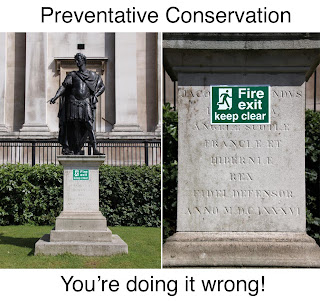
It seems kind of appropriate...
Manchester Hermit

BLOG POST - FROM THE GOOD NEIGHBOR POLICY TO THE FUNDACION AMISTAD: A USEFUL HISTORICAL REMINDER FOR OBAMA
Tuesday, June 23, 2009
Museum of Accidents?
The twentieth century can already be regarded as a museum of accidents. Take the history of film, of television, of video (including video games), and the biggest spectacle is the accident. It is not fortuitous that the Titanic has become a modern myth, or that television invents a new genre like “Reality-TV” to celebrate the accident. There certainly exists a desire to enjoy accidents. That is why I once proposed to set up a museum of accidents: a museum that would bring the accident to us instead of bringing us to the accident.—Paul Virilio.
Reflections on writing-up #15
Saturday, June 20, 2009
Them marbles (I'm losing them?)
Friday, June 19, 2009
LOLmuseum
Thursday, June 18, 2009
Research Week 2009: Reviews
Monday May 18, afternoon session
Looking back at the presentations on Monday afternoon, there is a common thread that sows the argument of both research projects. Mette and Pippa are analyzing how visitors, especially adults, engage with art works in museums. Though their takes on the matter are very different, since one is looking at discourse propelled by objects and the other at representations through drawing, their work is about understanding how museums become meaningful sites to individuals rather than generically to “audiences”.
Mette Houlberg Rung
Dialogic Spaces. Experiences in the collections at the Statens Museum for Kunst
Mette´s presentation focused on how audiences use the museum as a space of action, where narratives are produced between audiences, space and objects. As she dives into her research, after a few months of having it on hold, she is looking at how adults engage with the 2006 rehanging of the National Gallery in Copenhagen. Initially the methods of data collection included tracking sheets and observation at one of the galleries in the post 1945 art area; she then decided to record 14 pairs of conversations.
What these recordings reveal is the use people give to art pieces in order to draw in other “objects” outside of the museum that are relevant to personal stories. Thus dialogue here (taken from Bakhtin) is about an exchange between people stirred by objects and space, marked by previous experiences and future dreams, as well as imagined spaces.
In fact the majority of visitors are in the company of another adult. This particular use is confirmed by the questionnaires answered by the pairs who participated in the study where 50% say that a good museum experience comes about striking good conversations. Their main reason to visit is to have an experience with a companion rather than learning, in a more traditional sense.
There are two themes that Mette highlights: the relevance of personal experience in relating to art works and the construction of social narratives in the formation of identities. Mette interprets the widespread use of judgments as a legacy of educational policies in Denmark, which encourages learning not as knowledge intake but rather as opinion formation. It is interesting how the use of the museum is done in cultures of discussion where learning is more about the development of the self in a social context.
A particularly interesting point in her presentation, following Michel de Certeau, is how the museum exists when people use it. This leads us to rethink the ways in which traditionally art museums have conceived their exhibitions as results of enlightened curators that expect audiences “to get” the discourses and art pieces in a particular exhibition. In a different model, curators of art could look at patterns of consumption as possibilities in the creation of narratives.
There was a short discussion at the end about the use of texts, which Mette said were hardly read. The issue might have to do with the fact that audiences are more educated and older and might not feel they have to read, plus only a minority is there for the first time. Ceri mentioned that this phenomenon says something about how we are conditioned to look at art and Amy commented how having no text might force people to really look at art works.
Pippa Sherriff
Drawing Engagement. The relationship between people and objects as viewed through the people who are encouraged to draw in museums of art and design
Pippa´s research is focused on the mediation of drawing in the relationship between people and objects in the museum. She mentioned previous research done in 1997, which shows that participatory activities encourage people to engage in art. This is significant because though governments might emphasize cultural experiences, there is self-exclusion and thus understanding how people engage with art works can be of relevance for projects undertaken.
Her research was carried out in the Lady Lever Art Gallery, Liverpool, with two participants as well as her own experience of drawing. Though she believes that more participants need to be included, Richard thought this might be unnecessary if the data was rich enough.
As far as her paradigm and where she is standing to analyze her data, Pippa stressed the use of bricolage as a way to connect the parts to the whole, where individual experiences are interpreted in the light of meanings for the totality. She follows the phenomenographic approach, where material collected reveals people´s experience and their constructions of that reality. Autoethnography also became an important source of data, as well as the significance of the drawings themselves in order to reveal how drawing encourages reflection and problem solving.
Visual tasks might get the brain to work in ways that are different. Pippa was critical of the use of digital technology because it is an instant record of our experience. She believes it suspends the reference (object), and instead the act of drawing allows the meaningful reconstruction of a tangible object and thus gives meaning to our engagement with art (Though I find this theory interesting, I am not in agreement since I have also seen how young people “appropriate” things in an exhibit when they take pictures of themselves with objects).
To the question of how to avoid romanticizing the experience of drawing, Pippa mentioned the use of the various experiences, including her own. Sandra pointed to the interesting tactile relationship between a person and an object that drawing encourages, while Sheila mentioned how Pippa´s research will dive into a particular form people use to make meaning for them.
Monday, June 15, 2009
CFP: Spring 2010 issue of 'Exhibitionist'
For the Spring 2010 issue of "Exhibitionist," the exhibitions journal that I edit (www.name-aam.org), we want to look at issues that come up over and over again in developing and designing exhibitions - like should we do an intro film? Are dioramas out forever or in again? Strong lighting for accessibility or low lighting to preserve objects? Artifacts or props, etc?
I'm soliciting examples of any exhibition frictions you would like to contribute, and am especially interested in those that have been addressed creatively. Any ideas? I'd love to hear them. I would like to hear from you by end of June 2009.
Thanks, Gretchen Jennings
Gretchen Jennings
Editor of Exhibitionist
Journal of the National Association for Museum Exhibition
Washington, DC
www.name-aam.org
202-244-5329
gretchenjennings@rcn.com
--
H-MUSEUM
H-Net Network for Museums and Museum Studies
E-Mail: h-museum@h-net.msu.edu
WWW: http://www.h-museum.net
Special Option Module Museum Management: Politics and Policy (University of Leicester, Department of Museum Studies)
The University of Leicester, Department of Museum Studies is offering a new Special Option Module for its campus based programmes, for 2009-10:
Museum Management: Politics and Policy
This option will deliver a high level understanding of the theoretical discussions which inform key contemporary cultural policy debates and an understanding of the development and delivery of strategic museum policy. Thus, this option will have both a theoretical and practical orientation. It will involve analysis and discussion of cultural and museum theory and analysis and discussion of gray literature (policy, strategy, reports).
The option will involve detailed consideration of key issues in relation to museum politics and policy such as: what is the public value of the museum; should museums be used for instrumental ends or is this a betrayal of their real function; who is the museum visitor and who is the non-visitor, does not going to museums matter? How can museums respond to the needs of their funders while maintaining and developing their own programming aims?
See http://www.le.ac.uk/ms/study/Management-Politics&Policy.html for details of the Special Option Module and http://www.le.ac.uk/ms/study/study.html for all our programmes of study.
Jim Roberts
******************************
Webmaster
University of Leicester
Department of Museum Studies
http://www.le.ac.uk/museumstudies
+44 (0)116 252 3961
******************************
The University of Leicester's Department of Museum Studies has the highest
proportion of world-leading research in any subject in any UK university
(RAE 2008)
--
H-MUSEUM
H-Net Network for Museums and Museum Studies
E-Mail: h-museum@h-net.msu.edu
WWW: http://www.h-museum.net
Seminar: Museums as Social Enterprise (London/UK, 21 July 2009)
One-Day Seminar
London, 21 July 2009
"Advancing a social mission through entrepreneurial earned income strategies" - this is what Social Enterprise is all about.
And by launching new initiatives for the long-term unemployed, offenders, people with disabilities, or sustainability, museums are increasingly adopting this approach. As well as having a positive impact, these initiatives can - and are - generating significant extra income. In this small-group seminar, UK and international experience will be shared, and both recent research studies and current initiatives used, to highlight the current results and future potential of this important new trend.
Social Enterprises are businesses whose social or environmental purpose is central to what they do. It's about making things happen; about using skills to make a difference. Social enterprises often break with conventional business models to find new and more sustainable ways of improving the world around them.
From History to Policy
In the UK, the social enterprise tradition can be traced at least as far back to 1840s to Rochdale, where a workers' co-operative was set up to provide high-quality, affordable food in response to poor factory conditions. The original store is now itself a museum.
The concept is now a key element of Government strategy, with the Social Enterprise Unit forming part of the Office of the Third Sector, within the UK Cabinet Office.
Now, more and more museums - including the Eden Centre and the Museum of East Anglian Life - are finding that this model reflects the range of services they want to provide. This seminar aims to explore whether the approach can and should be more widely adopted within the museum community.
This event is primarily aimed at museum professionals who have some experience in this area, however limited, or who are seriously interested in engaging with it in future. Speakers will include Tony Butler, Director of the Museum of East Anglian Life, Stowmarket and other leading UK and international practitioners in the field.
This event will be based at the stylish Hoxton Hotel in Central London, and will start at 10.00 and end by 17.00.
Delegate fee: £245 includes lunch, refreshments and resource materials.
Contact:
Graeme Farnell
MuseumsEtc
8 Albany Street
EH1 3QB Edinburgh
Great Britain
graeme.farnell@gmail.com
0131 467 2791
www.museumsetc.com
--
H-MUSEUM
H-Net Network for Museums and Museum Studies
E-Mail: h-museum@h-net.msu.edu
WWW: http://www.h-museum.net
Applicant, by Jesse Reklaw

'Applicant' by Jesse Reklaw:
Friday, June 12, 2009
CFP: Museums, material culture and the British Empire (London/UK, 29-30 October 2009)
The British Museum and National Maritime Museum
29 - 30 October 2009
The symposium as described below on "Museums, material culture and the British Empire" will take place on 29 and 30 October 2009 at the British Museum and the National Maritime Museum. There are still a few spaces in the programme for speakers and we would be delighted to hear from any scholars whose work fits into the following themes and would be interested in presenting a paper.
Further information will be available on registering to attend the symposium in July.
The establishment of museums throughout the British Empire is increasingly recognised as part of the context of imperialism in the nineteenth and twentieth centuries, both practically and symbolically. This symposium will build on the ground-breaking work of John MacKenzie in his latest book, Museums and Empire (forthcoming with Manchester University Press). A range of papers will explore the relationship between museums, as repositories for objects and cultural institutions for conveying knowledge, and the politics of culture and the formation of identities in the British Empire.
As the work of Professor MacKenzie has shown, museums responded to their locations, perceived audiences and the agency of individual collectors in order to mediate an engagement with non-European spaces, peoples and cultures. This symposium will bring together scholars working on issues such as the history of colonial museums, the historical display and interpretation of empire, and the establishment of 'museum networks' in the British imperial context.
Possible themes for papers include:
- Museums and their meanings in the colonial context
- Collecting and curating in the British Empire
- Role of objects and display in the formation of colonial identities
- Museum networks in the British Empire
- Architecture of museums in the British Empire
Unfortunately, due to limited funding, we will not be able to provide assistance towards speakers' travel or accommodation, although refreshments will be provided. Those wishing to present a paper should contact Sarah Longair (sarah.longair@gmail.com) or John McAleer (jmcaleer@nmm.ac.uk) by 1 July 2009.
Sarah Longair
Birkbeck
--
H-MUSEUM
H-Net Network for Museums and Museum Studies
E-Mail: h-museum@h-net.msu.edu
WWW: http://www.h-museum.net
CFP: The Story of Things (Manchester, Jan 2010)
PLACE: Manchester Metropolitan University
DATE: Friday 29th January, 2010
The production, consumption and interpretation of narratives in visual form is central to contemporary cultures. Within this context, the notion of narrative finding expression in the visual can be traced, for example, in the growth of the graphic novel form, the positioning of cinema as subject matter for art practice and the persistence of the artist's book as an art form. Visual narratives demand specific forms of readerly interaction and critical response. They require a shift of reading focus from text to text-and-image or to image-only, and therefore require different critical apparatus and analytical skills.
This one day conference will investigate the reading of narrative in visual contexts, encouraging interdisciplinary approaches in addressing the following specific clusters of concerns:
- Authoring and reading the sequential narrative: linear and non-linear approaches.
- Visualising the remembered narrative: archetype, biography, autobiography.
- Object as catalyst: the potential for narrative within the artefact.
These areas of related interest will facilitate aesthetic and theoretical interrogations of visual narrative.
Papers are invited which explore or respond to issues of visual narrative production, consumption and interpretation in relation to these and other connected areas of concern. We encourage contributions from artists, academics and other practitioners. Please send proposals (250 words) for papers (20 mins) to: Jonathan Carson at j.carson@salford.ac.uk <mailto:.carson@salford.ac.uk> by Tuesday 1st September, 2009.
Jonathan Carson
Lecturer in Critical & Contextual Studies (0.8 - Monday, Tuesday,
Wednesday & Friday)
T: +44 (0) 161 295 6712
E: J.Carson@salford.ac.uk
School of Art & Design, The University of Salford, HT211 Centenary
Building, Salford, M3 6EQ.
--
_______________________________________________________________________
H-ARTHIST
Humanities-Net Discussion List for Art History
E-Mail-Liste fuer Kunstgeschichte im H-Net
Fragen an die Redaktion / Editorial Board Contact Address:
hah-redaktion@h-net.msu.edu
Beitraege bitte an / Submit contributions to:
h-arthist@h-net.msu.edu
Homepage: http://www.arthist.net
_______________________________________________________________________
Research Week 2009 reviews
Thursday, June 11, 2009
Make me a witness
I have been lucky enough over the years to hear several Holocaust survivors speak about their experiences. Due to my age, and theirs, these were usually child prisoners or smuggled children at the time, and in fact, this made it even more powerful, because they were "our age" then. But thinking about it more analytically, what I have just realized is the paradoxical simultaneity of these narratives: they were both highly personal, and yet somehow blend into the accepted version of a Grand Historical Narrative. It's the same thing as happens in documentaries - you hardly ever hear a dissenting voice say "no, that's not how it was for me!" And even if they do (I can think of a couple of WWII documentaries I've seen, in which unrepentant Russian or German prison camp guards were interviewed) they are the immediate villain.
So it makes me wonder - if we already have this Grand Narrative Truth in our heads, and whatever else we hear either falls in line with it and therefore tugs at our conscience, or goes against it and we therefore reject it outright - what is the impact of witness stories?
Wednesday, June 10, 2009
Make no mistake, museums are political
It takes incidents like this to remind me that museology isn't just about "pushing dust around," as my mother says - museums are lightning rods for socio-cultural views. I'm just sad that instead of the Enlightenment dream of presenting and debating things reasonably and with evidence, this man decided to take the violent way.
Collecting as it happens
It's a paperweight from the Natural History Museum (useful for keeping all those bits of paper I've written my thesis upon under control).
Science is not a popularity contest
Anyhoodles, back to the news. The Science Museum in London has published its Top Ten most significant objects list:
- Steam engine
- V2 rocket engine
- Electric telegraph
- Stephenson's Rocket
- X-ray machine
- Model T Ford
- Penicillin
- Pilot ACE Computer
- DNA double helix
- Apollo 10 capsule
Except, of course, that's a bit misleading, because the double helix isn't really an object, and I'd be surprised and disturbed if they had a live Penicillin culture in their stores. So what are we voting for, then? Objects, or the ideas they represent?
As museologists, I think we should all be concerned. Not only is the Science Museum trivializing scientific achievement by conflating artefacts and ideas, and asking the public to vote on their significance, but I am dead-set against the idea of a reality-TV-show-style vote in favour of, or against museum objects. Granted, nothing is in danger of getting voted out, but sometimes museums contain things in their stores, the significance of which isn't immediately recognised. Plus (and this might inspire some disagreement), I think the Museum has a responsibility to interpret these things, not just let us, the undereducated public, once again rely on our mass-media-fed cliched perceptions. Engendering debate, as the quote below seems to suggest, is the point of this list - but how can you argue without knowing the facts?
The museum's chief curator, Tim Boon, wants the top 10 to spark debate about the value of inventions and discoveries.
"What did we miss, is there an alternative top ten? Some of the objects may divide opinion. Would we be better off if some of the icons, which have had negative consequences, had not been invented?"
Who came up with this list, anyway? Nowhere do I see a justification for why these items, and not others, made it to the list. Finally, a list like this, at least for me, shows in stark relief why museums merely give the illusion of global intellectual representativeness, and actually are strange, esoteric collections of mere stuff. Surely, a Copernican model of the solar system is more representative of human intellect, aptitude, and achievement in science and technology than the arbitrary choice of the Apollo 10 capsule? What about the first paper published on germ theory, or going further back, Antony von Leeuwenhoek's descriptions of baccilae, versus penicillin? Shouldn't we be debating the concept of such a thing as scientific heritage "icons", instead of promoting it further?
I think the thing that bothers me about this popularity contest is that it is run by a museum. It's frankly irresponsible. This isn't like the contest for icons of British design run by The Culture Show a few years ago - that was done by a media outlet, but at least it had "experts" weighing in on the choices, and explaining them! Here, we are once again faced with the monolithic authority of the museum, except with a pretense toward democracy and debate, but without any real way of meaningfully doing so. The objects won't change; their meanings won't be debated; and nothing new will be discovered. The public doesn't even get to weigh in on a new acquisition, or something of real lasting value to any international scientific legacy. Most gallingly of all, this flies in the face of the spirit of scientific inquiry. What on earth does the curator mean, "would we have been better off had some things not been invented?" Yes, Oppenheimer repented of the use of atomic weapons, but that doesn't mean he repented of the process that made it be.
So, what's the point of this list? What can the museum or the public gain? No, really - I want to know!
Tuesday, June 09, 2009
Museums on Flickr
Monday, June 08, 2009
Comments Policy
Research Week Review: A home is a house that’s lived in
Kieran Burns is in his PhD looking at historic houses or homes in Ireland and trying to incorporate a critical approach. He does not see the audiences as empty vessels, but instead people that project their own ideas of history onto the historic sites when focusing on what stories historic houses tell and how.
The one idea that I found really interesting is Kieran’s idea about the perceiving at the house as a concept of home. A home is a shared idea across cultures and everyone can relate to what a home is. In this way he is not just dealing with big estate homes, but also with smaller scale history with homes of working class families or buildings converted to provide refugees with a home.
How do the audience relate to these different concepts of home? How do they perform their own identity in relation to the way they experience the historic home?
Research Week Review: From Representation to Commodity
This is of course problematic in terms of objects disappearing from the public realm and perhaps is not looked after in a proper way in the private collections that they might end up in. But what is also problematic is the shift in the status of the object from representing a culture, artist or trend in history to becoming a commodity. Especially when dealing with art objects the status as commodity is not a foreign one, but in museums artworks have up till now been more or less unaffected by the changing tends in the thieving art marked. Only when acquiring and insuring artworks the museum must deal with the marked price of an object. Or have they?
The interesting question behind this ethical issue that has arisen due to financial crisis is how neutral the collecting of museums is in the first place. How ethical and representative is a collection? And by deaccessioning does the museum really disturb a true representation of the past? Boris Groys, the German theorist, have dealt with this in his Die Logic der Samlung – the logic of the collection. Here he describes how a collection is being formed by the personal taste of a curator, or the fact that it fits the grand museum architecture so popular today or how the holes in a collection need to be filled in order to present the current understanding of what artists cannot be omitted when presented a given period in time. It is all in flux and all collecting is contingent. Of course this is not to say that all entry and exit of artworks into a collection is completely unproblematic. Especially when dealing with selling artworks to cover running cost, which is properly not the most sustainable strategy of museum management! However, it does put a perspective on the fact that both including and expelling artworks from a collection is a very complex situation and it raises the question whether acquisition is innocent in the first place. Perhaps a global recession and its financial consequences is just one of the conditions that shape the future of the collection along with many others.
Research Week Review: Mum, I met Napoleon today!!
With her presentation Ceri Jones kicked off the second day of the Museum Studies Research Week with some of the most intriguing questions when dealing with, not only living history, which is her topic, but also when discussing museums and objects in general. For are history museums and their displays about the past? or are they more a testimony to how we today perceive the past? When engaging with an art object in the art museum can it tell you something about the past? (the artist’s feelings for example) or are you projecting your own perceptions of the past/the artist onto the canvas?
From a postmodern perspective authenticity and the aura of the past have long been contested, but they still seem to be concepts which continue to attract and fascinate us – the real objects are still powerful and lure us in.
Ceri’s way into this is though living history – the re-enactment (by actors) of a historic situation, event, person etc. in a museum in order to make the past become alive. But is it possible to create a real sense of the past? The goal is to immerse the audience in an experience where they feel touched by the past, where it becomes tangible and where it is not just about what happened and what it looked like, but also show museum users why people acted and understood the world as they did. The audience can have a dialogue with someone from the past – or that is what is pretended. Through case studies with younger students, older students and MA students, Ceri have started to investigate the reaction of the audiences to this type of re-enactment.
What I found the most interesting and perhaps also the most troubling was Ceri’s last comments about what living history seem to do – or not do. She described how the students engaged with the enactment in several ways, but they did not question the actual content of the play. To me that mean that the critical approach to history is being lost in this interpreting strategy as enactment history is. I think one of the most important lessons in history class is to be able to critically judge the way the past have been portrayed and to reflect on why we tell the tale of the past in a certain way. Having said that I think living history plays an important role in drawing the students in and making them interested in history – but this interpretation should not stand alone. What do you think?
Sunday, June 07, 2009
Wednesday, June 03, 2009
Publication: International Journal of Heritage Studies 15:2/3
Special Issue:Heritage and the Environment
This new issue contains the following articles:
Contributors
Contributors, Pages 101 - 103
DOI: 10.1080/13527250903011037
Link: http://www.informaworld.com/openurl?genre=article&issn=1352-7258&volume=15&issue=2&spage=101&uno_jumptype=alert&uno_alerttype=new_issue_alert,email
Editorial
Heritage and the Environment, Pages 104 - 107
Authors: Hugh Cheape; Mary-Cate Garden; Fiona McLean
DOI: 10.1080/13527250902890597
Link: http://www.informaworld.com/openurl?genre=article&issn=1352-7258&volume=15&issue=2&spage=104&uno_jumptype=alert&uno_alerttype=new_issue_alert,email
Articles
Marginal Lands? An Overview of the Environmental Contexts of Cultural Landscapes in the Highlands and Islands of Scotland, Pages 108 - 141
Authors: Patricia Macdonald; Angus Macdonald
DOI: 10.1080/13527250902890605
Link: http://www.informaworld.com/openurl?genre=article&issn=1352-7258&volume=15&issue=2&spage=108&uno_jumptype=alert&uno_alerttype=new_issue_alert,email
The Landscape of the Gaelic Imagination, Pages 142 - 152
Author: Meg Bateman
DOI: 10.1080/13527250902890613
Link: http://www.informaworld.com/openurl?genre=article&issn=1352-7258&volume=15&issue=2&spage=142&uno_jumptype=alert&uno_alerttype=new_issue_alert,email
Àite Dachaidh : Re-connecting People with Place—Island Landscapes and Intangible Heritage, Pages 153 - 162
Author: MÃ iri Robertson
DOI: 10.1080/13527250902890639
Link: http://www.informaworld.com/openurl?genre=article&issn=1352-7258&volume=15&issue=2&spage=153&uno_jumptype=alert&uno_alerttype=new_issue_alert,email
Towards an Exhibition of Highland Art, Pages 163 - 174
Author: Murdo Macdonald
DOI: 10.1080/13527250902890647
Link: http://www.informaworld.com/openurl?genre=article&issn=1352-7258&volume=15&issue=2&spage=163&uno_jumptype=alert&uno_alerttype=new_issue_alert,email
Balancing Environmental and Cultural Impact against the Strategic Need for Wind Power, Pages 175 - 191
Author: Simon Clarke
DOI: 10.1080/13527250902890688
Link: http://www.informaworld.com/openurl?genre=article&issn=1352-7258&volume=15&issue=2&spage=175&uno_jumptype=alert&uno_alerttype=new_issue_alert,email
Dynamics of Informal Networking: Two Studies of Cattle Draft in the Perspective of Deeper Time, Pages 192 - 208
Author: Cozette Griffin-Kremer
DOI: 10.1080/13527250902890712
Link: http://www.informaworld.com/openurl?genre=article&issn=1352-7258&volume=15&issue=2&spage=192&uno_jumptype=alert&uno_alerttype=new_issue_alert,email
Homeland Emotion: An Emotional Geography of Heritage and Homeland, Pages 209 - 222
Author: Amanda Kearney
DOI: 10.1080/13527250902890746
Link: http://www.informaworld.com/openurl?genre=article&issn=1352-7258&volume=15&issue=2&spage=209&uno_jumptype=alert&uno_alerttype=new_issue_alert,email
The Eco-tourism of Cultural Heritage Management (ECT-CHM): Linking Heritage and ‘Environment’ in the Okavango Delta Regions of Botswana, Pages 223 - 244
Author: S. O. Keitumetse
DOI: 10.1080/13527250902890811
Link: http://www.informaworld.com/openurl?genre=article&issn=1352-7258&volume=15&issue=2&spage=223&uno_jumptype=alert&uno_alerttype=new_issue_alert,email
The Southern Upland Way: Exploring Landscape and Culture, Pages 245 - 257
Authors: V. Bold; S. Gillespie
DOI: 10.1080/13527250902890944
Link: http://www.informaworld.com/openurl?genre=article&issn=1352-7258&volume=15&issue=2&spage=245&uno_jumptype=alert&uno_alerttype=new_issue_alert,email
Heritage Conservation in Post-colonial Hong Kong, Pages 258 - 272
Author: Tracey L. -D. Lu
DOI: 10.1080/13527250902890969
Link: http://www.informaworld.com/openurl?genre=article&issn=1352-7258&volume=15&issue=2&spage=258&uno_jumptype=alert&uno_alerttype=new_issue_alert,email
Tuesday, June 02, 2009
Best Headline Ever!
Yeah, well, given the choice, wouldn't you? ;-)