Saturday, October 31, 2009
Atmosphere
Thursday, October 29, 2009
A New Digital Media Website
New Center at UC Irvine to Seed Research and Collaboration on Digital Media and Learning
Oh yeah, H-Net...
Museum Computer Network Webcasts
Hello everyone,
The Museum Computer Network is pleased to announce that five MCN 2009
sessions will be webcast live, free of charge. MCN 2009 takes place week
after next in Portland, Oregon. While we urge everyone who is interested
to attend the conference in person as the only way to engage with its
full array of workshops, sessions, events, exhibitors, and networking
opportunities, we know that some are unable to do so because of
especially acute funding issues this year.
If you can't be with us at the conference, we hope these webcasts may
enable you still to benefit from some of its knowledge sharing. If you
find this useful, we encourage you to join MCN to help support these
efforts for the wider community.
The webcasts will be on Thursday and Friday, November 12 and 13. We'll
use Twitter to harvest online questions during Q&A in those sessions,
which are:
Museum Data Exchange
Tweets to Sweeten Collaborations for Archives, Libraries, and Museums
Libraries, Archives, and Museums: From Collaboration to Convergence
Ramping Up while Scaling Down: Strategic Innovation in Challenging Times
2009 Conference Roundup Roundtable
<http://www.mcn.edu/mcn2009online> has more information.
Short URL <http://bit.ly/mcn09oL> leads to the same page.
Please plan to join us online even if you can't join us onsite!
Rob Lancefield
President, MCN
Wednesday, October 28, 2009
Call for Comments!
This is just one of your friendly web-elves reminding all those who read this blog to please feel free to comment! We love getting your input, and we know that you're out there. The Attic gets a wide readership and it would be so nice to hear your views on what we write here. So please, comment away.
Let dialogue commence!
Van Gogh Letters
Van Gogh Letters
The Neues Museum
The Neues Museum Website
The Project on David Chipperfield Architects
Brown Bag Review 28/10/09: The Pitt-Rivers Museum
Visiting Speaker: Alison Petch (Senior Research Associate and Registrar, Pitt Rivers Museum, University of Oxford)
Title: Muddying the waters: The Pitt-Rivers collection from 1850-2009.
Augustus Henry Lane Fox Pitt-Rivers (1826-1900) used typological distinctions to think about the artefacts in his extensive collections. He was an important contributor to the development of anthropology as a discipline, and a museum subject, between 1850 and 1900. He believed that ethnographic and archaeological collections were vital tools in the study of contemporary and past human cultures.Alison's talk focused on evolution, both in terms of socio-technological evolution as Pitt-Rivers perceived it, as well as the evolution of the collection and museum themselves. Having started collecting in 1852, by 1874, when some of his collection was displayed at Bethnal Green Museum, Pitt-Rivers' belief in using a natural history approach toward the classification of ethnographic and archaeological material had crystallized into a demonstration of the linear progression of design and technology from the simple to the complex. Through the exhibits, organized by typologies and series, Pitt-Rivers' explicit political aim was to demonstrate to the under-educated museum-going public that improvement of material conditions was a slow and gradual evolution, not to be gained by revolution. As his relationship with the authorities of the South Kensington Museum [now the V&A, parent body to the Bethnal Green museum] deteriorated, P-R began a new collection in Farnham, Dorset, where he sought to educate the agricultural workers of that remote area. These educational goals were probably at the core of his decision to donate the Bethnal Green/ South Kensington Collection to Oxford in 1883.
Pitt-Rivers divided his artefacts by type of artefact, either by use or function, or by the decorative designs inherent in it. These divisions were not only intellectual but physical, visible in the museum displays of his collection in London from 1874 to 1884 and again, for his private collection, at Farnham in Dorset between 1880-1900.
The Pitt Rivers Museum was founded in 1884 on the understanding that the University of Oxford would carry on Pitt-Rivers' general method of arrangement of objects during his lifetime and the agreement that any changes after that date would only be instituted if the advance of knowledge required it. In reality, however, changes were wrought almost immediately and Pitt-Rivers' categorisations altered as new artefacts were constantly added to his typographical series. This paper will examine the history of these events and contextualise it in the light of the conclusions Pitt Rivers, his peers and his successors, drew from them.
While initially the same fittings and arrangements were used for the Oxford displays as had been in London, changing curatorial interests (with the legal transfer of the collection to the University, P-R himself ceased to be involved, and a succession of professional, academic curators were appointed to maintain and develop the Museum) and the continued arrival of new artifacts meant that displays were constantly rearranged - contrary to popular belief about the PRM being a time capsule of Victorian anthropology. Using the example of tribal shields, Alison compared the initial arrangement of the displays by type and evolutionary series to a later, more contextualized arrangement which compared items by geographic region. She also challenged the notion that the museum's space (not just the interiors of cabinets) was static by presenting an unrealized plan for a rotunda-style building, as well as by pointing out the numerous interventions and rearrangements of thematic displays and temporary exhibitions. She concluded, however, that whereas the evolution of the museum had been roughly in line with contemporary preoccupations in the wider museum community, this had somewhat problematically and unreflexively clashed with the initial mission for the museum, and had led to an unclear statement of purpose for the raison d'etre of the displays as they have evolved.
Alison's talk was an excellent example of well-researched institutional history, serving as an example of the curatorial and collecting pitfalls frequently warned against in museological literature. It was also a surprising report on the actual confused state of the displays in the Museum, frequently assumed to be static and "frozen in time." Some questions remained unanswered - for example: how did the original displays compare with other epistemological systems evident in other, similar museums and collections of the time? How can the PRM make clearer its current aims and objectives while staying true to its idiosyncratic history? Perhaps Alison's new research project, focusing on the now-lost Farnham collection, can go some ways toward illuminating the unique, and also the common aspects of this historic collection.
Bosworth Field: Not where you think it is
Tuesday, October 27, 2009
The Age of Destruction
Yet More Dinos!
And it's good to know that local fossil hunters are still going strong. But that the environment is being managed too.
Sea Monster
Digital Strategies for Heritage Conference
Here's the link for you techno-buffs,
DISH
Monday, October 26, 2009
CFP/New Publication: Journal of Art Historiography
Call for contributors
This journal will publish its first issue on 31st December 2009 and will appear every six months thereafter. It intends to offer a focus for the study of art historiography. Its mission statement reads:
This journal exists to support and promote the study of the history of art historical writing. Much of this practice has been shaped by traditions inaugurated by Giorgio Vasari, Winckelmann and German academics of the
nineteenth and early twentieth centuries. Consequent to the expansion of universities, museums and galleries, the field has evolved to include areas outside of its traditional boundaries.
There is a double danger that contemporary scholarship will forget its earlier legacy and that it will neglect the urgency and rigour with which those early debates were conducted. The earlier legacy remains embedded in
'normal' practice. More recent art history also stands in need of its own scrutiny. The journal is committed to studying art historical scholarship, in its institutional and conceptual foundations, from the past to the present day in all areas and all periods.
This journal will ignore the disciplinary boundaries imposed by the Anglophone expression 'art history' and allow and encourage the full range of enquiry that encompassed the visual arts in its broadest sense as well as topics now falling within archaeology, anthropology, ethnography and other specialist disciplines and approaches. It will welcome contributions from young and established scholars and is aimed at building an expanded audience for what has hitherto been a much specialised topic of investigation.
Besides articles, it will accept notes, reviews, letters and translations. It will be published every June and December and include both peer-reviewed and commissioned contributions.
The Editor invites submissions from interested scholars.
For more information see:
http://www.gla.ac.uk/departments/arthistoriography/
____________________________________________________________________
H-ARTHIST
Humanities-Net Discussion List for Art History
E-Mail-Liste fuer Kunstgeschichte im H-Net
Editorial Board Contact Address / Fragen an die Redaktion:
hah-redaktion@h-net.msu.edu
Submit contributions to / Beitraege bitte an:
h-arthist@h-net.msu.edu
Homepage: http://www.arthist.net
____________________________________________________________________
Brown bag Seminar (28th October)
Organising team: Sandra Dudley & Julia Petrov Visiting Speaker: Alison Petch (Senior Research Associate and Registrar, Pitt Rivers Museum, University of Oxford)
Title: Muddying the waters: The Pitt-Rivers collection from 1850-2009.
Augustus Henry Lane Fox Pitt-Rivers (1826-1900) used typological distinctions to think about the artefacts in his extensive collections. He was an important contributor to the development of anthropology as a discipline, and a museum subject, between 1850 and 1900. He believed that ethnographic and archaeological collections were vital tools in the study of contemporary and past human cultures.
Pitt-Rivers divided his artefacts by type of artefact, either by use or function, or by the decorative designs inherent in it. These divisions were not only intellectual but physical, visible in the museum displays of his collection in London from 1874 to 1884 and again, for his private collection, at Farnham in Dorset between 1880-1900.
The Pitt Rivers Museum was founded in 1884 on the understanding that the University of Oxford would carry on Pitt-Rivers' general method of arrangement of objects during his lifetime and the agreement that any changes after that date would only be instituted if the advance of knowledge required it. In reality, however, changes were wrought almost immediately and Pitt-Rivers' categorisations altered as new artefacts were constantly added to his typographical series. This paper will examine the history of these events and contextualise it in the light of the conclusions Pitt Rivers, his peers and his successors, drew from them.
UoL History of Art Public Lecture Series Autumn 2009...
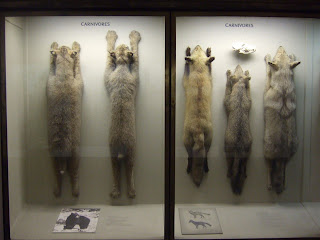
Gallery Chat: The Carnivores

While I'm Spamming the Attic...
Beyond Distance Research Alliance Festival
Hope you all had a good weekend!
Jen
Saturday, October 24, 2009
The Allosphere
http://www.allosphere.ucsb.edu/research.php
It just makes you think about how arts and sciences can come together. And it also makes me wonder...is there really that much difference?
Friday, October 23, 2009
Two Conferences for you
Museums and Restitution
And the second is something I thought was cool. But then I would!
The Gothic
Have a good weekend all, and Anna - Good Luck!
Survey on Handheld Guides
Hi All.
I would like to draw your attention to an online survey into the use,
challenges + future of mobile interpretation in museums. See
http://tr.im/ALUg
'Thank you' to all those that have taken the survey already. Since
its launch a couple of weeks ago we've had over 100 responses, and the
findings are already pretty telling. We're hopeful the community will
find them interesting and valuable.
The final research findings - inc. the raw data - will be published
online so as to enable anyone to collaborate in interpreting the data.
The survey was developed together with Learning Times, hosts of the
2009 Handheld Conference Online last June. With mobile interpretation
becoming an increasingly ‘hot-topic’ for museums, and with the medium
becoming evermore powerful/ubiquitous, we thought it would be
interesting to identify:
1. why museums use (or don’t use) handheld guides
2. the challenges relating to their use
3. how they saw the medium’s future
4. and how to improve knowledge share in this field
If you’ve not taken the survey yet, it would be fantastic if you could
please find 10 minutes to do so. The survey is ‘open’ to all museums,
whether you use handheld guides and/or are interested in doing so or
not. And obviously, the more responses we get, the more interesting
the results. Add to that, UK-based museums are a little
under-represented at the moment!
The survey is online at http://tr.im/ALUg
We hope you chose to respond, and look forward to sharing the results
later in the year!
Loic Tallon & Learning Times.
The Big Microbe Knit
For those on Ravelry (the knitter's Facebook) click here for the patterns.
Event: Brown Bag Seminar Wednesday 11th November
University of Leicester
Brown Bag Seminar
Wednesday, 11 November @ 1pm
Steph Mastoris, Head of the National Waterfront Museum in Swansea, is going to talk on: 'When does the opening end? Taking the long view of establishing a new museum.'
Whilst the museum opened to much acclaim in 2005, Steph would advocate it has taken some years to assess how a new museum really functions and to rectify all those good ideas that in actuality didn't work
The seminar will be in the Collections Room for a 1pm start
All welcome!
Conference: Exhibitions as Research (Glasgow, 15-17 Apr 10)
Exhibitions as Research: Theory, Practice, Problems
(Session in 36th AAH Annual Conference, 15-17 April 2010, University of Glasgow)
Deadline for submission: 9 November 2009
Ideally, exhibitions always present audiences with new research. When exhibitions are outcomes of individual academic research projects, however, the research undergoes a process of translation. Under the guidance of curators and other museum and art gallery staff, art historians discover how to turn their work into a phenomenological and conceptual experience that communicates not only with their academic peers but also with public audiences, not only through the act of writing about objects and ideas, but also through encountering them and placing them in space and time. As a collaborative situation, the process of exhibition-making can, for some academics, become a form of research in itself.
In this session, the term 'research' is inclusive, incorporating conventional art historical research, research conducted by artists and curators, and other research practices. Forms of research may range from traditional scholarship which informs large-scale survey or blockbuster exhibitions such as Gothic: Art for England, 1400-1547 (V&A, 2003) and Babylon: Myth and Reality (British Museum, 2008/9), and more focused academic exhibitions such as Freud's Sculpture (Henry Moore Institute, 2006) and Close-Up: Proximity and defamiliarisation in art, film and photography (The Fruitmarket Gallery, 2008/9), to artist-led research as in Tacita Dean's An Aside (Hayward National Touring Exhibitions, 2005). This session will consider how research is translated in exhibitions of art from any period, from medieval to modern and contemporary. Questions include: How can display be used to express an argument, explore a concept or even work against the presentation of research? How can interpretation support or extend academic research? What role can contemporary art play to inform exhibitions of historic objects, and vice versa?
Deadline for submission of paper propsals: 9 November 2009. Please contact the session convenors with an abstract (no more than 250 words long), and your name, institutional affiliation and contact details.
Session convenors: Dr Stacy Boldrick (Research and Interpretation Manager, The Fruitmarket Gallery; interpretation@fruitmarket.co.uk) and Stephanie Straine (Exhibitions Organiser, The Fruitmarket Gallery; support@fruitmarket.co.uk ).
Additional contact details: The Fruitmarket Gallery, 45 Market Street, Edinburgh EH1 1DF; (p) +44 (0)131 225 2383; (f) +44 (0) 131 220 3130.
Dr Stacy Boldrick
Research and Interpretation Manager
P 00 44 (0)131 226 8183
F 00 44 (0)131 220 3130
E interpretation@fruitmarket.co.uk
www.fruitmarket.co.uk
The Fruitmarket Gallery
45 Market Street, Edinburgh, EH1 1DF
____________________________________________________________________
H-ARTHIST
Humanities-Net Discussion List for Art History
E-Mail-Liste fuer Kunstgeschichte im H-Net
Editorial Board Contact Address / Fragen an die Redaktion:
hah-redaktion@h-net.msu.edu
Submit contributions to / Beitraege bitte an:
h-arthist@h-net.msu.edu
Homepage: http://www.arthist.net
____________________________________________________________________
Thursday, October 22, 2009
University of Toronto Journals...
http://www.facebook.com/pages/Journals-University-of-Toronto-Press/148645031723?v=wall
Twitterpated
Wednesday, October 21, 2009
Value Added
CFP: Social History Curators Group
The Social History Curators Group
Annual Conference
Birmingham, 8-10 July 2010
More for Less: Big Impacts with Small Resources
Museum professionals are experts at utilising creativity, verve and imagination to overcome the potential limitations of small resources. At different times we are all likely to face the difficulties of shrinking budgets, limited funding options and overburdened resources.
This year's conference tackles these problems head on, and shows you how you can rise to the challenge and provide high quality and engaging experiences for your visitors. Topics covered will include proven strategies from previous times of economic difficulty and recent case studies that have demonstrated innovation and inspiration despite various restrictions
SHCG are pleased to invite proposals from across the museum profession, for presentations which address one or more of the core conference themes
Survival stories; how museums have coped with resource cuts and limitations
Engaging and increasing your audiences without increasing your costs
Creative ways of working with small budgets; examples relating to collections, interpretation, partnerships, learning and marketing
Minimising the environmental cost; sustainability and recycling
Developing partnerships with libraries, archives and children's centres
Digital technologies; new solutions for age-old problems
Please email proposals for presentations to Hannah Crowdy, by 1st February 2010.
Proposals for a 30 minute presentation should include a 200 word summary of the presentation, contact details and institutional affiliation (if any).
Speakers’ travel and subsistence costs can be reimbursed (travel reimbursed at standard rail fare rate) and there will be no attendance fee on the day of speaking.
The Social History Curators Group was formed to improve the status and provision of social history in museums and the standards of collections, research, display and interpretation. The group acts as a forum for sharing ideas and practical experience with others involved in social and local history in museums.
Best wishes,
Jim
![]()
******************************
Jim Roberts Hon FMA
Webmaster
University of Leicester
School of Museum Studies
http://www.le.ac.uk/museumstudies
+44 (0)116 252 3961
******************************
Tuesday, October 20, 2009
Sensory Archaeology
http://www.cai.siuc.edu/vspages/day/vsconf.html
CFP: Making Things
First Call for Papers
`Making Things'
Museum Ethnographers' Group (MEG) Annual UK Conference 2010
Monday and Tuesday 12-13 April 2010
Museum of English Rural Life, University of Reading
From technological interpretations through to gallery-based artistic interventions, museum ethnographers have long grappled with issues of creativity and with the physical techniques and social forces that underpin the making of our material worlds. However, in recent years other topics—collecting processes, disciplinary histories, and questions of `materiality'—have come to the fore, often at the expense of pragmatic and material-centred relationships between people and things. This conference seeks to re-engage with the practical elements of the profession.
As museum ethnographers we facilitate the passage of material culture from its physical construction amongst source communities through to its careful management in the applied contexts of everyday museum practice. Echoing this, we seek papers that explore the broad theme of `making things'. These might relate to manufacturing processes, field-collecting methods, conservation techniques, exhibition design, creative intervention, educational resource production, or even the means by which institutions themselves have come into being.
It is hoped that the resultant conference will include several sessions comprising traditional papers as well as at least one session involving practical activities, interactive opportunities, and less formal experiences. As such, the organisers are very keen to hear from potential speakers who wish to deliver hands-on displays or who are keen to incorporate the actual `making of things' into their contribution. For example, these might include demonstrations of conservation approaches, artistic performances, or exhibitions of manufacturing techniques. There may also be scope for demonstrations—internal or external—in the breaks between sessions.
Papers will be 20 minutes in length with an additional 10 minutes for questions. There will also be a work-in-progress session comprising shorter presentations of 10 minutes in length. Conference contributions may be considered for publication in the Journal of Museum Ethnography published annually by the Museum Ethnographers' Group.
For further information or to propose and discuss papers, sessions, demonstrations, or performances please contact:
Ollie Douglas
Museum of English Rural Life, Redlands Road, Reading, RG1 5EX UK
[+44] [0]118 378 8660
o.a.douglas@reading.ac.uk
The closing date for submissions and abstracts is Friday 15 January 2010
Monday, October 19, 2009
Morbid Sightseer
Museum in a Day
I was walking around Leicester today and I realised what a city of contradiction it is. Such great beauty, greenery and grandeur, then turn widdershins and there is poverty, homelessness and degradation. It is a city of faded glory, a former lordship and stronghold. Somewhere within it lie the bones of a villified king fallen in battle, the forgotten remains of a great Roman bath house, all hidden below the modern city. Leicester is, in so many ways, a bricolage assemblage of every era of history.
Publication: Museum History Journal Vol. 2 (2009), No. 2
Edited by Hugh H. Genoways and Mary Anne Andrei
July 2009
Vol. 2, N. 2
----------------------------------------------
*Table of Contents*
From the Editors
FEATURE ARTICLES
Our Works of Ancient Times: History, Colonization, and Agency at the 1906-7 New Zealand International Exhibition - Conal McCarthy
The Public's Signatures: Visitors' Books in Nineteenth-Century Museums -
Liesbet Nys
Taking Pictures: Looting, Preservation, and Photography During World War II
- Catherine Roach
Universities, Museums, and Civic Formation: A Case Study of the University of Toronto Museum of Natural Science, 1840-1890 - Lynne Teather
BOOK REVIEWS
El Desierto en una Vitrina: Museos e historia natural en la Argentina, 1810-1890, by Irina Podgorny and Maria Margaret Lopes - reviewed by Kristy Wilson Bowers and Don E. Wilson
Lost in the Museum: Buried Treasures and the Stories They Tell, by Nancy Moses - reviewed by Henry Nicholls
Curiosity and Enlightenment: Collectors and Collections from the Sixteenth to the Nineteenth Century by Arthur MacGregor - reviewed by Valentina Pugliano
----------------------------------------------
TO ORDER this issue or to subscribe to the bi-annual Museum History Journal,
visit our website at: http://www.lcoastpress.com/journal_issue.php?id=126[1]
Journal ISSN: 1936-9824
Issue ISBN: 978-1-59874-829-1
For more information, contact Stefania Van Dyke at Museums@LCoastPress.com
STEFANIA R. VAN DYKE
Museum Studies and Practice
LEFT COAST PRESS, INC.
Museums@LCoastPress.com
Journal orders: 925-935-3380
Book orders: 800-621-2736, 773-702-7000
Fax: 800-621-8476, 773-702-7212
1630 N. Main Street #400
Walnut Creek, CA 94596
www.LCoastPress.com
--
H-MUSEUM
H-Net Network for Museums and Museum Studies
E-Mail: h-museum@h-net.msu.edu
WWW: http://www.h-museum.net
Event: Museums, Inclusion, Engagement (London/UK, 14 December 2009)
London, Monday 14 December 2009
Museums | Inclusion | Engagement is a highly-practical, information-packed one-day event in which leading professionals involved in the fields of inclusion and engagement within museums and galleries will share their experiences and insights.
Among the key issues to be addressed will be:
* how to obtain sustainable, ongoing funding to support long-term programmes which make a difference
* how to evaluate the short- and long-term impact of your projects
* how to reaching the most excluded groups or individuals
* how to prioritise your work among the various communities
* how to use new community-based communication media
* how to build the right organisational structure to deliver effective programmes
* what can be learnt from the experience of other sectors working in these fields
Presentations from a range of highly experienced speakers will include strategic overviews, practical how-to sessions, and detailed case-studies.
Who should attend?
The seminar is designed for professionals involved in: social inclusion initiatives; community outreach and engagement; audience development; access initiatives; learning and education; project management; organisational
development; interpretation, design and information; marketing and communication; human resources; and visitor services.
We are currently releasing a limited number of places at a reduced rate of £147, saving a full 25% on the normal rate of £197. These reduced-rate places will be sold on a first-come, first-served basis. Order online at www.museumsetc.com/?p=933
DEADLINE: 12 December 2009
--
H-MUSEUM
H-Net Network for Museums and Museum Studies
E-Mail: h-museum@h-net.msu.edu
WWW: http://www.h-museum.net
NaReWriMo
Sunday, October 18, 2009
Object Retrieval: The ultimate interdisciplinary research project
...what happens when you bring together minds from such diverse specialisations and focus them on the same item?
- asks the Londonist.
Thursday, October 15, 2009
Are you a Museopunk? Part Deux
Talk: Cultural diplomacy
Museums for World Peace?
| Photo: © Jessica Long |
But can culture really ease international conflict and foster tolerance? Or does looking to old objects to find messages of tolerance for today meaning obscuring the contemporary reasons behind conflicts? Does assigning cultural institutions such a role risk undermining their more traditional goals, or even compromise their scholarly objectivity? What kind of relationships should Western cultural institutions have with their counterparts abroad, and to what purpose? What role, if any, can and should museums play on the international stage?
Speakers:
Dr. Stephen Deuchar, Director of Tate Britain
Dr. Tiffany Jenkins, sociologist; Director of the Arts & Society programme at the Institute of Ideas
Jonathan Jones, Art Critic of the Guardian
Andrea Rose, Director of Visual Arts at the British Council
Tim Stanley, Senior Curator, Middle East at the V&A, as well as the principal author of Palace and Mosque: Islamic Art from the Middle East
Claire Fox, Director of the Institute of Ideas and panellist on BBC Radio 4's Moral Maze
£10 (£8 concessions), booking recommended
A revolution in collection?
As any good student of museology should know, the MA describes disposal as ethical when:
• it is within the framework of a clearly defined collections policy
• it is on the advice of a range of staff (not an individual) and is agreed by the governing body
• it is done with the intention that wherever possible items remain within the public domain
• it is unlikely to damage public trust in museums
• it is likely to increase the public benefit derived from museum collections
• it is communicated openly to stakeholders and the public.*
Points 3 and 6 are often achieved by advertisement in the Museums Journal; in a format somewhat akin to 'classified listings' in the local rag. Though, of course, these items are not 'for sale' in the conventional sense, just free to a good (institutional) home.
Since I first subscribed to the MJ back in 1998 the disposal notices have fascinated me; what weird and wonderful things museums have in their possession (and desperately want to relieve themselves of)!
The new online listings make equally fascinating reading. Got a hankering for back issues of Practical Wireless? Then the Royal Signals Museum can help you out. Need an Edwardian witness box? North Lanarkshire Council will do you a 'deal'. Require a low-tech printing solution? Dover Transport Museum's Arab Press could be just what you're after.
* see - Disposal Toolkit: Guidelines for museums, Museums Association, 2008.
Fast Food?
And then I read this. McDonalds is to open in Le Louvre, or more correctly, in the shopping centre adjacent to the museum.
Discuss.
Wednesday, October 14, 2009
Go Dino!
Monday, October 12, 2009
CFP: The Museum 2010 (Taipei/TW, 17-19 May 2010)
National Taipei University of Education, Taipei/Taiwan
17 –19 May, 2010
An international conference exploring the value, purposes and priorities of museums at the start of the 21st century
In recent years, museums and galleries around the world have had to contend with shifts in the political, economic, social and technological environments they inhabit that have had profound effects across the cultural sector. At a time of significant change, this conference provides an opportunity to reassess and re-examine the value, purposes, and priorities of museums. The conference aims to provide a forum for an interdisciplinary and international exploration of the meaning, function and impact of museums and a platform for discussion of issues and ideas that are relevant to the contemporary museum world.
The conference organisers are inviting proposals from delegates wishing to present 30-minute papers, or 90-minute colloquium sessions. These can be academic papers with a theory or research focus, or presentations describing how initiatives have been put into practice.
Themes:
Social responsibility of museums
Museum management, policy and marketing
Collections, interpretation and design
Engaging visitors: museum communication and education The digital museum
Who Should Attend?
Museum practitioners
Researchers, academics and research students Policy makers and senior managers
Confirmed Keynote Speakers:
Diane Lees, Director General, Imperial War Museum; Robert Janes, Editor-in-Chief, Museum Management and Curatorship; Simon Knell, Professor of Museum Studies, University of Leicester; Richard Sandell, Director of Museum Studies, University of Leicester; Suzanne MacLeod, Deputy Head of Museum Studies, University of Leicester
Call for Papers:
All those interested in presenting papers at the conference are requested to submit an abstract in English of their proposed paper by 15 December 2009 by email attachment (the document should be made with Word 2003 compatible application) to Dr. Yung-Neng LIN (email: museum2010@gmail.com). The abstract should not exceed 300 words and should include the following information:
Author name(s)
Email address
Affiliation and position
Title of paper
Authors will be notified of the acceptance of their proposals by the end of January 2010. Accepted authors must submit papers or case studies of between 1500 and 3000 words in English (3000 – 5000 in Chinese) by 15 March 2010 by email to Dr. Yung-Neng LIN. All proposals, presentations and papers must be in English or Chinese.
Enquiries may be sent to: Dr Yung-Neng LIN
Email: museum2010@gmail.com
Instructions for Papers:
The guidelines for submitting a paper will be sent to each of the contributors.
Registration:
Registration is free.
Coffee breaks, lunches & dinners are US$50; please pay on arrival.
The organisers are also offering US$200 towards travel costs for up to 20 overseas participants who submit a paper. Applicants will be assessed on the basis of the quality and relevance of their submission to the conference aims and themes.
Organisation:
Sponsors: Council of Cultural Affairs, Taiwan
Organisers: The University of Leicester; National Taipei University of Education; National Taiwan University of Arts; Taipei National University of the Arts; Fu Jen University
Co-Organisers: Chinese Association of Museums Japan Museum Management Academy Tokiwa University, Japan
Secretariat for the Conference
All correspondence and questions concerning the conference should be directed to:
Department of Cultural Industry, National Taipei University of Education, 134, Sec. 2., Heping E. Road, Taipei, 106, Taiwan
E-mail: museum2010@gmail.com
--
H-MUSEUM
H-Net Network for Museums and Museum Studies
E-Mail: h-museum@h-net.msu.edu
WWW: http://www.h-museum.net
Publication: Journal of Museum Education Vol. 34 (2009), No 2
A Publication of the Museum Education Roundtable "Educational Leadership"
Editor: Elizabeth L. Maurer
Summer 2009
128 pages; Vol. 34, N. 2
------------------------------------------------------------------------
*Table of Contents*
From the Editor – Elizabeth L. Maurer
Guest Editor's Introduction: The Museum Educator Crisis – Tina R. Nolan
Recessionary Layoffs in Museum Education: Survey Results and Implications – Ron Kley
Welcome Mr. Director and Good Luck! – Rafael Rosa
Sidebar One: Growth and Leadership without Advancement, A Case Study – Rafael Rosa
A Conversation about Educational Leadership in Museums – Leslie Bedford
Sidebar 2: How to Survive a Graduate Program While Working Full-Time at a Museum – Amy Schwartz
Shared Professional Knowledge: Implications for Emerging Leaders – Lynn Yuen Tran and Heather King
Benchmarking: Education on the Road – Maria Mingalone
A Scenario for the Future of Museums – Mary Kay Cunningham
From the Margins to the Center: Recommendations for Current and Aspiring Educational Leaders – Tina R. Nolan
The Leader's Bookshelf: Suggestions for Reading More about Change Leadership – Tina R. Nolan
----------------------------------------------
TO ORDER this issue, visit our website at: http://www.lcoastpress.com/journal_issue.php?id=127
Journal ISSN: 1059-8650
Issue ISBN: 978-1-59874-821-5
Stefania R. Van Dyke
Museum Studies and Practice
Left Coast Press, Inc.
Museums@LCoastPress.com
Journal orders: 925-935-3380
Book orders: 800-621-2736, 773-702-7000
Fax: 800-621-8476, 773-702-7212
1630 N. Main Street #400
Walnut Creek, CA 94596
www.LCoastPress.com
--
H-MUSEUM
H-Net Network for Museums and Museum Studies
E-Mail: h-museum@h-net.msu.edu
WWW: http://www.h-museum.net
Saturday, October 10, 2009
Staffordshire Hoard Appeal
JennyW
Thursday, October 08, 2009
http://museum.thinkport.org/
http://www.dreammuseum.org/
Made me think about a couple of things in terms of museums and the web.
Thought the First: We can all be curators now. What value does this accord to collections that are placed into the public domain? Who has the right to accord these things their value?
Thought the Second: I've been thinking a lot recently about the space within which the museum "experience" occurs. In online environments, this experience must be modified in some way. The ease of accessing collections is something of a conundrum, for this access via a computer could be seen to be more removed from tactile apprehension than ever. While a computer might only be able to provide auditory and visual experiences of an object, what other sensory experiences might it be able to offer that seeing the actual object could not?
The experience, for certain, would be different - but would it be worse? World Wide Web or other computer experiences can be incredibly multilayered and rich, as is the case with such hypertextual resources as The Victorian Web, or the more graphical environments of 3D gaming.
Ah, musings that come to you when you've fallen asleep in the middle of the afternoon. I think that suggests an early night for me...
Materiality & Intangibility: Provisional programme
Materiality and Intangibility: Contested Zones
A two-day international symposium for PhD students and early career researchers.
Monday 14th and Tuesday 15th December 2009.
Day 1
9.30am REGISTRATION
10.00am WELCOME (Dr Richard Sandell, Head of the School of Museum Studies)
10.30am KEYNOTE: Dr Sandra Dudley (University of Leicester)
12.00pm Gestsson & Iervolino – An attempt to challenge the role of Art in the Public Sphere: embarking on a “journey” with a contemporary artwork
12.30pm LUNCH
2.00pm Visit to Live Art Event
2.30pm Fitzpatrick – Offerings at the Wall: An exploration of the artefacts from the Vietnam veterans’ war memorial Washington
3.00pm Wang – Looking for the subjectivity of British-Chinese in English Museums
3.30pm TEA & COFFEE
3.45pm Pieren, Lester & Marchant – Filling the void between museum displays and cultural identities to empower museum visitors
4.15pm Owain – Dynamic Music and Myths: DVD content as object.
5.00pm Visit to Live Art Event
6.30pm Group Dinner/Social Event
------------------------------------------------------------------------------------------
Day 2
9.30am TEA & COFFEE
10.00am KEYNOTE: Dr Kostas Arvanitis (University of Manchester)
11.30am Scott & Vine - Crafting the Viewer’s Experience: Digitizing the Maya
12.00pm Visit to Live Art Event
12.30pm LUNCH
2.00pm Moore – The Material in the Immaterial: An archive of 1930’s film from Angola and Namibia, and contemporary physical and material responses
2.30pm Wade – The Unknowable Exhibition: using the archive to reconstruct the 1839 Leeds Public Exhibition of Works of Art, Science, Natural History, and Manufacturing Skill
3.00pm Powell – Curating Chances
3.30pm TEA & COFFEE
3.45pm Gadsby – The Affect of Encouraging Emotional Values in the Interpretation of Real Objects
4.15pm Woodall – Lost and Found: The Mary Grey Collection
5.00pm KEYNOTE: Emeritus Professor Susan Pearce (University of Leicester)
Wednesday, October 07, 2009
CFP: Museums and Popular Culture
Popular Culture Association and American Culture Association
Libraries, Archives, Museums, and Popular Culture Area
The Popular Culture Association and American Culture Association annual conference will be held March 31 - April 3, 2010 in the Renaissance Grand Hotel St. Louis and across the street in the America's Center, in St. Louis, Missouri. Scholars from numerous disciplines will meet to share their Popular Culture research and interests.
The Libraries, Archives, Museums, and Popular Culture area is soliciting papers dealing with any aspect of Popular Culture as it pertains to libraries, archives, museums, or research. In the past this has included descriptions of research collections or exhibits, studies of popular images of libraries or librarians, analyses of web resources such as Wikipedia and YouTube, and reports on developments in technical services for collecting popular culture materials. Papers from graduate students are welcome.
Prospective presenters should send a one-page abstract with full contact information (electronic preferred) by November 30 2009, to:
Allen Ellis
Professor of Library Services
W. Frank Steely Library
Northern Kentucky University
Highland Heights, KY 41099-6101
USA
859-572-5527
FAX: 859-572-5390
E-Mail: ellisa@nku.edu
Monday, October 05, 2009
Hands Off!
All levity aside, though, it does raise the old beast of a question about materiality in museums. Let's face it, people still want to touch certain things! And I have little doubt that if there was actually an option to pay more to look at a painting of one's choice over lunch in the cafeteria, people would take it!
So, in the spirit of the impossible, if you could fondle any object in any museum, which would it be? And how much would you pay for the privilege?
(I want to sleep in the Great Bed of Ware at the V&A - I'd pay up to a thousand pounds for that.)
Friday, October 02, 2009
Historical photographs of Leicester Market
I've got some jolly nice postcards of it too!


The Market seems to me to be one of the few constants in the development of the city over the last couple of hundred years. I noticed, as I walked through this afternoon, that traders are concerned about its continued future, worried that the Council has plans to evict them. Frankly, after the Bowstring Bridge debacle, nothing would surprise me about LCC.