Monday, November 30, 2009
An Attic Advent
Why not support a museum or heritage organisation while you shop for Christmas?
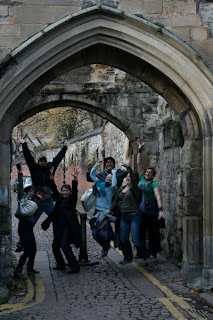
Jumping for joy


Now that's happiness!
Sunday, November 29, 2009
Flashdance!
UK Museums on the Web 2009: The Everyday Web: Situated, Sensory, Social
http://museumscomputergroup.org.uk/2009/11/25/uk-museums-on-the-web-2009-situated-sensory-social/
If you're interested, do please read along!
What's the New Mary Jane?
As I peruse the headlines now, it occurs to me that post-secondary education might be the new credit. Desperate to revive their economic clout, leaders of Western nations are pushing towards injecting skilled labour into the workforce and encouraging people to return to university and take up learning skills deemed necessary by the government: finance, international development, business, marketing, etc. There is threatening talk of punishing those universities who graduate people with softer skills, like in the humanities - certainly funding-wise, this already happens in terms of bursaries and scholarships - and governments, while cutting overall financial support for education and loans, is throwing money at advertising the necessity of "competitiveness" in the global economy. At the same time, government rhetoric has it that mere access to education is a marker of social progress, and encourages access by students of all classes to programs in any discipline. Thus, universities swell with numbers, and while the rhetoric of social inclusion continues, the only equality gained is an equality of unemployment for all. Students saddled with enormous debt and even greater expectations of social and fiscal remuneration will graduate into a society where the economy no longer rewards their skills. The amount of equally-qualified people around them will increase, and they are uncompetitive with those who already have workplace experience. So the promise of buying yourself social mobility, this time in education as opposed to goods, once again fails to deliver.
And there is inflation here, too - A BA became the new high school diploma a long time ago. Recently, Master's degrees became the new BAs for professional disciplines. PhDs, as opposed to being rare, are now increasingly common. University departments seek tor ecruit ever more student numbers of PhDs to gain government funding and overall prestige, without real thought to what these students will do with their PhDs once they graduate. The premise of a PhD - original research into a specialized topic - has remained the same, but increasing numbers and the passage of time has meant more and more obscurantism in topics chosen, and therefore less and less applicability to the world outside. Sure, it's fun while you're doing it, but the experience is not the only part of the journey - eventually, there has to be a destination. If the destination is essentially a pyramid scheme where specialists in the arcane encourage more and more disciples, who have to take on disciples of their own to justify their existence, you create a education bubble that will have to burst sometime because supply outsrips demand.
It seems to me that all this is a result of the de-industrialization of the West. In an economy where there is opportunity for a range of labour - skilled and unskilled, applied and intellectual - education serves to specialize the workforce, and to provide social capital to those most specialized. As factories all over Europe and North America close, and production moves overseas, the focus on the consumer economy and the service industries grows. Education, therefore, becomes about educating and encouraging the consumer to consume, as well as marketing itself as a commodity. The entitlement of the marketplace ("I deserve the best I can pay for, even if it means with credit") transfers over to knowledge - "I deserve to study because I want to." It's an enormous priviledge, but not one without consequences, as its uncontrolled growth is ulimately unsistainable. Perhaps education is also the new global warming.
This is not meant to be some kind of Conservative, right-wing railing against the demise of the idyllic past where workers doffed their caps at squires. What the present has brought has been a much-needed opening-up of access to education (though that is still not ideal). Neither do I intend to pack it all in, and become a plumber or carpenter or electrician in "the honest trades." (I'm too spoiled by the system to dream of giving up my priviledge unless forced to do so by necessity.) What I wish to point out is that even from my pinko-liberal point of view, it is obvious that education still has to have a goal, and it is increasingly questionable whether its premise is tenable.
Now... back to researching my own obscure topic. Cancer cure, it ain't.
Thursday, November 26, 2009
Dark Tourism: Titanic Memorial Cruise 2012
Via the 'Dark Tourism' listserv, the following is an extract from the marketing publicity for a cruise commemorating the Titanic's fated maiden voyage…pretty ghoulish if you ask me.
British travel firm Miles Morgan Travel are taking reservations for this unique cruise that will commemorate the Titanic's tragic voyage in April 1912.
![]()
Our voyage of a lifetime will sail from Southampton on 8th April 2012 the twelve night cruise on board the MS Balmoral and will follow the RMS Titanic's original itinerary, passing by Cherbourg on the French coast before calling into the Irish port of Cobh.
From here the ship will sail across the Atlantic, arriving at the Titanic site on April 14th/15th exactly 100 years on from this tragic voyage, where a memorial service will be held to pay tribute to the brave passengers and crew who perished on that fateful night.
![]()
The voyage will then continue to Halifax, Nova Scotia, the final resting place of many who were on board, before sailing on to New York, the Titanic's ultimate planned destination.
This is obviously a unique event and such is the interest in the 100th anniversary of the Titanic it is highly recommended that a booking be made as soon as possible.
REFS: http://www.titanicmemorialcruise.co.uk/
REFS: http://www.worldhum.com/travel-blog/item/the-titanic-memorial-cruise-tasteless-or-touching-20091007/
The BBC and British Museum announce ‘A History of the World’ - a unique and unprecedented partnership focusing on world history for 2010
This interested me, and I wondered - how would you tell your history in your objects?
Wednesday, November 25, 2009
Success!
It's me next...*shudder*
Sunday, November 22, 2009
A Film Review: New Moon
Friday, November 20, 2009
Research Seminar: Cultural Landscapes, cultural policy and the politics of identity
School of Museum Studies Brown Bag Seminar 25th November, 2009
Dr Lisanne Gibson
School of Museum Studies
Abstract: Cultural landscapes, cultural policy and the politics of identity
This paper will discuss the ways in which outdoor cultural objects construct and assert particular forms of identity. I will consider a broad range of outdoor cultural objects which refer to a selection of identity formations. Traditionally, the consideration of the significance of outdoor cultural objects, including memorials and public art, has valorised particular modes for understanding the significance of objects. In relation to public art, for instance, art and architectural theories have judged the aesthetic or design qualities of an object to be the aspect of most importance. However, many outdoor cultural objects do not fit into the canons of traditional art or architectural history. Does this mean that these objects are of little or no value or significance?
A second and seemingly more democratic mode for the designation of an objects' significance is based on the importance of the historical story it represents in relation to dominant historical frameworks, such as national history. However, despite the hegemony of particular historical frameworks, and certain constructions of national identity and citizenship which travel hand in hand with these, history is not a single story but consists of 'histories' or 'layers' of history. It follows that the designation of significance too, is constructed and ever changing. The process of designating significance must be developmental rather than static if heritage policies and practice are to be democratic. The evaluation of significance is not a simple matter of recognition but an active designation, which has cultural, political and social effects.
This paper will explore the ways in which outdoor cultural objects can be articulated to powerful assertions of identity and memory either intentionally, by their creator, or subsequently, by a community's superimposing of meaning onto the object. Detailed research of outdoor cultural objects in the cultural landscapes of the State of Queensland, Australia has demonstrated that the affectivity of an object's functioning in this respect has little to do with the aesthetic significance of its appearance. Following from this, the paper will discuss the issues at stake in the protection and management of outdoor cultural objects. In particular I argue that heritage programs and organisations must actively take seriously pluralistic interpretations of categories of social and cultural significance, and that currently, despite the rhetoric to the contrary, they are not yet doing so. This is important because the protection and management of outdoor cultural objects is a matter, which has political and cultural consequences, and is thus of great significance, not least to the empowering of diverse cultural identities and the persistence of plural social memory.
UK Museums on the Web Conference 2009: The everyday web: situated, sensory, social
In 2008, Ross Parry, Programme Director for the campus-based Masters course, was elected National Chair of the Museums Computer Group. http://www.le.ac.uk/ms/contactus/rossparry.html He invites all our students and past students to join him on December 2nd at the UK Museums on the Web Conference 2009: full details below.
The cost for MCG members and full-time students is £15; for non members £40. For anyone interested in Museums and the Web, this is a 'Must Attend' event
UK Museums on the Web Conference 2009: The everyday web: situated, sensory, social
2 December 2009
Hochhauser Auditorium, Sackler Centre, V&A, London
See the finalised programme online at:
http://www.museumscomputergroup.org.uk/meetings/2-2009.shtml
Book now at:
For over five years the annual UKMW conferences have been the place for high quality presentations and discussions on the matters that are shaping museums online today.
By remaining in touch with the leading edge of research, the politics of policy, as well as the day-to-day realities of professional work, UKMW continues to appeal to practitioners and academics, technologists and curators, policy makers and the commercial sector. And the event has built a reputation for the caliber of its speakers, the accessibility of its content, and the focus of its debate.
As museums’ activity online continues to be drawn into the power and possibility of the social Web (of networking and user-generated content) and the machine Web (of semantics and APIs), this year’s conference takes us back to the everyday, sensory and ubiquitous experience and encounters of online content.
Today, the Web is becoming increasingly a more multi-sensory place, with new visual interfaces, rich sound content, where content can adapt to our physical location, and even where interactions can be triggered by bodily movement. Likewise, software and services (just like our content) can today move with us.
This year UKMW will look at digital heritage in the everyday - situated, sensory, social.
Programme
9.00 - 9.30 Registration and coffee
9.30 - 9.45 WELCOME AND INTRODUCTION
Ross Parry (Chair, Museums Computer Group)
Gail Durbin (Head of V&A Online)
9.45 - 10.45 SOCIAL
Chair: Bridget McKenzie (Director, Flow Associates)
Matthew Cock (Head of Web, British Museum) and Katherine Campbell (BBC)
Nadia Arbach (Digital Programmes Manager (V&A) and Mike Peel (Chair, Wikimedia UK)
Denise Drake (Web Officer, Tower Hamlets Summer University)
10.45 - 11.15 Mid-morning break - hosted by Cogapp.
11.15 - 12.15 SITUATED
Chair: Loic Tallon (Director, Pocket-Proof)
Andy Ramsden (Head of e-learning, University of Bath)
Paul Golding (Innovation Strategist/Evangelist, wirelesswanders.com)
Mike Ellis (Solutions Architect, Research & Innovation Group, Eduserv)
12.15 - 1.15 Lunch
1.15 - 1.45 'OPEN MIC' SESSION
Chair: Martin Bazley (Chair of the E-Learning Group for Museums, Libraries and Archives)
5-minute mini presentations and updates from the floor:
1.45 - 2.15 KEYNOTE
'Making the digital museum relevant in people's everyday lives'
Richard Morgan (Technical Manager, V&A Online)
2.15 - 2.45 MCG AGM
Including the launch of 'LIVE!Museum' - supported by the AHRC and BT.
During the AGM (agenda, previous minutes (PDF)), we'll be asking members to vote on some important changes to the constitution (PDF) that have come out of our 'MCG@25' consultation process - changes that will have a big impact on how the group is run in the future.
2.45 - 3.15 Mid-afternoon break
3.15 - 4.15 SENSORY
Chair: Mia Ridge (Lead Web Developer, Science Museum)
Anne Kahr-Højland (Experimentarium, Copenhagen)
Victoria Tillotson (iShed and the Pervasive Media Studio)
Joe Cutting (Digital consultant and developer)
4.20 - 5.20 ACCESSIBLE: digital culture past, present and future
Chair: Marcus Weisen (Director, Jodi Mattes Trust)
Helen Petrie (Director, Human-Comnputer Interaction Research Group, University of York)
5.20 - 5.30 Chair's closing remarks
5.30 - CONFERENCE CLOSES
UKMW09 is followed by the Jodi Awards 2009. The awards, this year presented by Martha Lane Fox, are now fully booked. Anyone attending the awards will need to have registered with the Jodi Mattes Trust. If you have any questions about attending the Jodi Awards 2009, please contact Marcus Weisen [marcus dot weisen at gmail dot com]
The event tag is #ukmw09.
We're looking forward to welcoming you all to UKMW09.
CONF: The Story of Things (Manchester, 29 Jan 20)
PLACE: Manchester Metropolitan University Special Collections
DATE: Friday 29th January, 2010
The production, consumption and interpretation of narratives in visual
form is central to contemporary cultures. Within this context, the notion
of narrative finding expression in the visual can be traced, for example,
in the growth of the graphic novel form, the positioning of cinema as
subject matter for art practice and the persistence of the artist's book
as an art form. Visual narratives demand specific forms of readerly
interaction and critical response. They require a shift of reading focus
from text to text-and-image or to image-only, and therefore require
different critical apparatus and analytical skills.
This one day conference will investigate the reading of narrative in
visual contexts, encouraging interdisciplinary approaches in addressing
the following ideas:
- Object as catalyst: the potential for narrative within the artefact.
- Visualising the remembered narrative: archetype, biography, autobiography.
- Authoring and reading the sequential narrative: linear and non-linear
approaches.
Keynote Speaker: Patricia Allmer - Relating the Story of Things supported
by REACT - www.creativetechnology.salford.ac.uk/react
<http://www.creativetechnology.salford.ac.uk/react> .
More about Patricia Allmer
Patricia Allmer is curator of Angels of Anarchy: Women Artists and
Surrealism at Manchester Art Gallery. She is Research Fellow in the
Manchester Institute for Research and Innovation in Art and Design
(MIRIAD) at MMU and has published widely on different aspects of art
theory. More information available at www.artdes.mmu.ac.uk/profile/pallmer
<http://www.artdes.mmu.ac.uk/profile/pallmer> .
Registration Fee: £30 (£15 concession)
To book, or if you have any enquiries regarding the conference please
contact Jonathan Carson & Rosie Miller at J.Carson@salford.ac.uk
<mailto:J.Carson@salford.ac.uk> or on +44 (0) 161 295 6712.
This conference is hosted by artists Carson & Miller with support from
University of Salford and Manchester Metropolitan University Special
Collections.
More about Carson & Miller
Jonathan Carson & Rosie Miller have collaborated since 2000. Their
practice is driven by their need to tell and re-tell stories; recent work
has increasingly used the book and game playing as methods for
collaboration. More information available at
www.carsonandmiller.blogspot.com.
For more information about Manchester Metropolitan University Special
Collections please go to www.specialcollections.mmu.ac.uk
<http://www.specialcollections.mmu.ac.uk/> .
_______________________________________________________________________
H-ARTHIST
Humanities-Net Discussion List for Art History
E-Mail-Liste fuer Kunstgeschichte im H-Net
Fragen an die Redaktion / Editorial Board Contact Address:
hah-redaktion@h-net.msu.edu
Beitraege bitte an / Submit contributions to:
h-arthist@h-net.msu.edu
Homepage: http://www.arthist.net
_______________________________________________________________________
Online conference: Inspiration Uploaded
Here is an online conference that may be of interest to you. It would be great to have some participants from the U.K.
Cal Martin
National Chair
Interpretation Canada
--------------------------
Registration is now open for Interpretation Canada’s first online conference.
Theme: Inspiration Uploaded
Tuesday to Thursday, 1–3 December, 2009
Presenters include Dr. Sam Ham, Lesley Curthoys and Peter Pacey.
Topics include visitor experience, social media, graphic design, theatrical and “dark” interpretation
Today’s members rate: CDN $97 www.learningtimes.net/ic/
Worried about the economy, H1N1, the costs of travel or lengthy approval processes? Let your worries melt away, as experts from across North America inspire you with cutting edge topics - delivered right to your computer.
No matter how remote your museum, park, or site, you will be connected to a thriving community of interpreters across Canada and beyond.
Our keynote speaker, Dr. Sam Ham, will discuss how the work we do can make a tangible difference in the world. So grab a coffee, log in, and join us for this exciting event!
Background:
Many participants in last November’s IC workshops saw using more technology as a key way forward for our association. IC board members are pleased to offer this opportunity back to you.
Why a partnership with Learning Times?
To ensure a streamlined online presence, Interpretation Canada has partnered with this US company. Learning Times is a leading producer of online communities and conferences, serving organizations with a learning-related mandate. Their clients include BCcampus.ca, Museum-Ed, and Smithsonian Learning.
Conference Details:
There will be six live online sessions, as well as our first-ever online AGM (Annual General Meeting).
Registration will give you access to all seven sessions as well as continued access to the recorded sessions for six months.
So if your time zone or daily work prevents you from attending all of the sessions, you will still have access.
Registration Fees:
These will be converted to your local currency when you pay, as with some other online purchases.
Early bird rates:
- US $90 for IC members
- US $150 for non-members
- Early bird rate is a US $10 discount - in effect until November 20.
- Non-member rate includes a one-year individual professional membership.
For more information and to register visit www.learningtimes.net/ic/
Get inspired, get updated, and get together - online!
membership@interpcan.ca
www.interpcan.ca
*************************************************************************************************
Professional development, networking, jobs and recruitment and more for heritage interpreters.
Interpretation Canada is a non-profit association of contributing members.
More information and membership form online at www.interpcan.ca
*************************************************************************************************
The Salzburg Global Seminar (SGS) and Salzburg Declaration on the Conservation and Preservation of Cultural Heritage.
The Salzburg Global Seminar (SGS) in "Connecting to the World's Collections: Making the Case for the Conservation and Preservation of our Cultural Heritage", Schloss Leopoldskron, Salzburg, Austria, from October 28 to November 1, 2009.
Dear Colleagues,
Greetings,
Prof. Dr. Hany Hanna, will participate in the Salzburg Global Seminar (SGS), "Connecting to the World's Collections: Making the Case for Conservation and Preservation of our Cultural Heritage," in Salzburg , Austria , from October 28 – November 1, 2009. The seminar, convened by SGS in partnership with the U.S. Institute of Museum and Library Services, will explore global themes, issues, challenges, and successes related to conservation and preservation, building on the IMLS initiative on collections care, Connecting to Collections: A Call to Action.
Seminar participants attend by invitation only and represent more than 35 countries in every region of the world. They are selected for their knowledge and experience in the field of conservation and preservation. Topics such as emergency planning for the protection of valued artifacts will be explored by the participants, leading to a report containing recommendations for worldwide action.
Prof. Hanna considered an International expert in conservation, he been invited to participate at the seminar because of "his own leadership and deep experience with conservation and preservation issues will provide invaluable insights and information as we seek to identify strategies and issues in the care of collections in a variety of contexts around the world. Since the seminar will be highly interactive, encouraging cross-cultural comparisons of data and experiences and providing both formal and informal opportunities to discuss and share best practices".
The general theme of the seminar includes five subjects include:
1) Emergency Preparedness, Response, and Recovery;
2) Raising Awareness and Support;
3) New Preservation Approaches;
4) Education and Training;
5) Assessment and Planning
To follow seminar blog posts by Richard McCoy, Assistant Conservator of Objects at the Indianapolis Museum of Art, please go to http://www.iiconservation.org/wpress/
Thank you very much
Prof. Dr. / Hany Hanna
- International Expert in Conservation and Restoration.
- Chief Conservator,
General Director of Conservation, Helwan, El-Saf and Atfeh Sector, Supreme Council of Antiquities
(SCA), Egypt .
- Professor, Institute for Coptic Studies in Cairo .
- Writer and Reporter, El-Qahera Newspaper , Egypt
- Founder & Former Coordinator for the WG of the International Council of Museum-Conservation
Committee - Wood, Furniture and Lacquer (ICOM-CC- Wood, Furniture and Lacquer).
- Mobil No.: +2-012-4176742
- E-mail: hhnnc@yahoo.com
CC: hhnnc@hotmail.com, hhnncc@gmail.com
http://groups.yahoo.com/group/ProfDrHanyHannaMillingList/
http://www.facebook.com/hhnnc
Travelgrants for ICOM GC, Shanghai 2010
Dear ICME member,
Information and applications for travel grants to the 22nd General Conference of ICOM to be held in Shanghai, November 7-10, 2010. Information can be found at the following website: [ http://icom.museum/general-conference2010.html ]http://icom.museum/general-conference2010.html. Please note that two types of travel grants will be available – grants for members from developing nations and grants for young members (40 years or younger).
Grant proposals are DUE in Paris by December 31st, 2009. Please refer to this website if you are eligible to apply. Please remember that you must be a member of ICOM. If you are applying with support from ICME, you must be a member of ICME or work for a museum which is an institutional member.
If you would like to apply with support from ICME, please send me a copy of the completed application so that I can send in a convincing support letter.
I encourage all ICME members who are qualified for this funding to apply for it so that our committee can be well represented at the triennial.
Annette
Annette B. Fromm 3060 Alton Road Miami Beach, Fl 33140 305-532-3530
----------------------------------------------------------
Peter Bjerregaard
Editor, ICME News
Moesgård Museum/
Dept. of Anthropology and Ethnography
University of Aarhus
Moesgård
DK-8270 Højbjerg
Denmark
Phone: +45 89424642
Fax: +45 89424655
CONF: World Heritage and Tourism Conference Abstract submission deadline
We wish to remind you of the approaching deadline for abstract submission (15 December 2009) for the following conference:
world heritage and tourism:
Managing for the global and the local
3-4 June 2010, Quebec City, Canada
As of 2009, approximately 900 sites are registered on the UNESCO World Heritage list. For many sites inscription on the World Heritage List acts as a promotional device and the management challenge is one of protection, conservation and dealing with increased numbers of tourists. For other sites, designation has not brought anticipated expansion in tourist numbers and associated investments. What is clear is that tourism is now a central concern to the wide array of stakeholders involved with World Heritage Sites. We increasingly need to understand the multi-layered relationships between the diverse range of Sites and tourism and tourists and, to focus on how tourism is effectively managed for the benefit of all.
This conference seeks to explore a series of critical and fundamental questions being raised by the various 'owners', managers and local communities involved with World Heritage Sites in relation to tourism: Why do tourists visit some World Heritage Sites and not others? What is the tourist experience of such Sites? How successful are Sites in the management of tourists? What roles do local communities play in Site management? How can the 'spirit of place' be protected in the face of the sheer volume of tourists? How can some Sites maximize the potential of a sustainable tourism for the purposes of poverty alleviation and community cohesion? How effective are communication strategies in bringing stakeholders together? What management skills are needed to address the needs of different stakeholders, different sites and different cultures?
We encourage papers from a wide range of disciplinary perspectives and welcome submissions which address theoretical, empirical, methodological, comparative and practical perspectives on the fullest array of themes associated with the management of UNESCO World Heritage.
CALL FOR PAPERS
Original papers are invited to consider subject areas including, but not limited to, the following themes:
* Marketing in the management of World Heritage Sites;
* The pragmatics of managing tourists;
* Financing World Heritage;
* Community involvement in Site management;
* Relations between intangible cultural heritage and Site management;
* The role of the private tourism sector;
* The nature of tourist experience and behaviour at World Heritage Sites;
* Shaping local, regional and national identities through Site inscription;
* Issues of governance and transnational regulation;
* Legal rights and notions of 'ownership';
* The management of World Heritage 'values';
* The geo-politics of inclusion and exclusion;
* Methods of Site evaluation;
* Managing spiritual values and biodiversity;
* The role of UNESCO and the political economies of designation.
Please submit your 500 words abstract (in French or English) including a title and full contact details as an electronic file to Professor Maria Gravari-Barbas (Maria.Gravari-Barbas@univ-paris1.fr <mailto:Maria.Gravari-Barbas@univ-paris1.fr> ) or Laurent Bourdeau (laurent.bourdeau@fsa.ulaval.ca <mailto:laurent.bourdeau@fsa.ulaval.ca> ) as soon as possible but no later than 15 December 2009.
Publication opportunity: Papers accepted for the conference will be published in the conference proceedings, subject to author registration. Best papers from the conference will also be considered for publication in a special issue of the Journal of Tourism and Cultural Change <http://www.tandf.co.uk/journals/rtcc> .
Conference Organisers: UNESCO/UNITWIN NETWORK for Culture, Tourism and Development, the Faculty of Business Administration at Université Laval, the Université Paris 1 Panthéon-Sorbonne and the Centre for Tourism and Cultural Change at Leeds Metropolitan University.
For further details on the conference at a later stage please visit www.tourism-culture.com <http://www.tourism-culture.com/> or http://www.fsa.ulaval.ca/tourisme <http://www.fsa.ulaval.ca/tourisme> .
=====
Daniela Carl
Centre for Tourism and Cultural Change
Faculty of Arts & Society
Leeds Metropolitan University
Old School Board
Calverley Street
Leeds
LS1 3ED
UK
phone +44 (0)113- 812 8541
fax +44 (0)113- 812 8544
www.tourism-culture.com
Thursday, November 19, 2009
Why I distrust polls....
Tuesday, November 17, 2009
Google Image Swirl
What do you think?
A Trip To Warwick Castle
.jpg)
I have waited many years to visit Warwick Castle. I am not sure of the exact year but I was fairly young when I found a guidebook to Warwick Castle in a jumble sale and bought it despite not living anywhere near Warwick at the time. And the fact that it dates from 1983. I am a bit strange like that though (if you haven't guessed so already) and also own a guide book to the Tower of London from 1977. I always meant to take said guide book with me when I finally made it to the castle but stupidly I forgot it. In the end I didn't even need it, everything felt so familiar because I had read the book so much it had somehow become stored in the dark recesses of my mind, obviously displacing some really useful information along the way.
Guy's Tower was also built in the fourteenth century and was named after the semi-mythical Earl of Warwick who lived in Saxon times. The Earls of Warwick reached their high point in the fourteenth and fifteenth century when their actions put them firmly in the political spotlight; Thomas de Beauchamp (1329-1369) rose to prominence during Edward II's reign and fought at the battles of Crecy and Poitiers, becoming military advisor to the Black Prince. He has a beautiful alabaster tomb in St Mary's Church in Warwick town centre where he lies with his wife, the bottom of the tomb decorated with many small figures which serves as a remarkable record of the fashions of the day. Also buried there is his grandson Richard (1401-1439) beneath a sumptuous metal cast; he was a friend to Henry V and tutor to the eventual Henry VI and was hanging around Rouen when Joan of Arc was burnt at the stake. His son-in-law Richard Neville became Earl by right of his wife, known to history as 'The Kingmaker' for his meddling in politics during the War of the Roses, one of the most complicated periods for the British monarchy, if not for the peasants who probably got fed up with all the confusion as to whom exactly was oppressing them that particular week. If you like Medieval history the castle has reconstructed several tableaux which take the visitor through the preparations for a battle through the perspective of the squire to Richard Neville 'The Kingmaker', who was killed at the Battle of Barnet (I was convinced that he had his head chopped off when he took off his helmet to take a drink of water in a quiet moment but according to wikipedia he was struck off his horse and killed). I quite enjoyed looking at the wax models, which we could move around and even touch, so despite the static nature of the piece the designers had gone to a lot of trouble with the costumes and layout. It was very brightly coloured as well, much better than the usual gloomy interpretation of Medieval life, although of course the emphasis on the Wars of the Roses highlights the barbaric nature of Medieval people as opposed to say the representation of the nineteenth century which we will come to in a minute.
Inside the decoration of the castle mainly dates from the seventeenth century and there are a number of grand and over-the-top rooms to explore. The present owners of the castle have tended to use wax models to recreate notable figures who would have visited the castle over its history; these often look incongruous to the surroundings and are not as fun as the Medieval recreation because you cannot get close to them in the same way. Henry VIII makes an appearance with his wives dutifully sat around him. Winston Churchill and the Playboy Prince Edward VIII also pop up. I wasn't really that interested in following the interpretation, which describes a 'Royal Weekend party , 1898' as I hinted earlier the gentile activities indulged in by the (probably bored) upper classes it is a contrast with the war-mongering Medieval types. I know which century I would rather live in, even if I would be party to at least one horrific skin disease and have absolutely no idea about hygiene. This would also chime with my excitement at being able to clamber about the castle ramparts and pretend to shoot arrows from the aptly named arrow slits and drop boiling oil from the gaps in the castellations.

Monday, November 16, 2009
Get back to where you once belonged (Volume 2: Bootylicious)
Congratulations, everyone, UK museums can now return artworks looted in WWII! What, you ask, they couldn't do this before? No, apparently not - national institutions cannot dispose of things in their collections, they could (prior to this law) just pay off the victims in the sum of the value of the looted artwork, which would remain safely in the keeping of the institution. Finders Keepers, and all that. I love how self-congratulatory the politicians are:
Culture minister Margaret Hodge said it was "a wonderful day" for families who "suffered so terribly during the Nazi era".
"For too long families who had heirlooms stolen from them by the Nazis were unable to reclaim them, although they were the rightful owners."
Anne Webber, co-chair of the Commission for Looted Art in Europe, said this was "a great step forward" that confirmed Britain's "commitment to providing justice".
A great step forward perhaps 70 years too late? Justice limited only to a very recent conflict, and one where the victims are generally white (ish, depending on who you talk to)? Maybe it's my hormones, but this kind of back-slapping small-mindedness makes me stabby.
Collector's Corner: Robin of Sherwood (TV programme)
Confernce Alert!
http://www.h-net.org/announce/show.cgi?ID=171961
May well be of interest :)
Dr Belle du Jour
Belle du Jour drops her anonymity (BBC News)
Friday, November 13, 2009
What to do with historic displays?
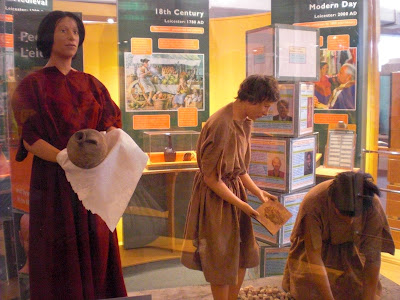
These questions have been bothering me since our PhD community Hallowe'en Museum Crawl round Leicester (podcast/photos coming soon!). Focused particularly upon a group of beautifully crafted, yet hopelessly outdated dioramas displayed at Jewry Wall Museum, Leicester's criminally neglected archaeology museum.
The dioramas were made for the 1951 Festival of Britain and thereafter bought by Leicester Museum Service. They depict family groups from the prehistoric to Anglo-Saxon periods of English history.

Until recently, the cases housing the dioramas were seemingly indiscriminately dotted about the museum wherever there was an empty space, kind of as an afterthought. They certainly did not belong to adjacent displays, their presence - silent, yet obtrusive - ruptured the otherwise chronological narrative (a similar fate still befalls several just as elderly figures representing characters from Chaucer's Canterbury Tales).
However recently they have been reincorporated into the display as key didactic objects. A new label does admit their 'shortcomings', that ideas about these historical periods has developed over the intervening decades. And yet, even if it is not the intention, the figure groups otherwise inhabit the gallery space unchallenged. To the average visitor there is no reason to doubt their veracity, their objectivity, their scientific basis in reality. Indeed, the museum has recently commissioned a new figure group depicting Roman craftsmen laying a mosaic floor. Highly problematic.
But they are beautiful and fascinating for what they reveal of archaeological knowledge and museum practice 60 years ago. They deserve to be exhibited.
Do you see the paradox?
The Leicester Brown Bag Theatre Presents...
Taking the Long View of Opening a New National Museum.
Steph Mastoris, National Waterfront Museum, Swansea
Given the School of Museum Studies' recent move into a newly renovated building, the Brown Bag seminar which was held in the Collections Room today was particularly pertinent. The speaker was Steph Mastoris, director of the recently opened National Waterfront Museum in Swansea, a character well known to a number of people in the department. His easy persona, sense of humour and ability to be honest allowed a much deeper and richer access to the lessons that we could learn from his own experiences of working with a new building.
The content of the talk? Steph spoke of the trials, tribulations and joys of setting up a new museum. The title 'When Does the Opening End?' directly challenges the idea that once a museum has been opened, that's it, there's nothing more to do. While it's true that opening a museum certainly marks a huge turning point in that institution's life, it does not mean that the teething problems have all been sorted out, and this is what Steph came to show us.
The project began as a partnership between National Museums Wales and Swansea City Council funded by the HLF. It was based on the pre-existing collections of both of these organisations, that of the Welsh Industrial and Maritime Museum in Cardiff, and the Dockside Warehouse Museum respectively. Both of these institutions had problems, including gender imbalance in attendees, a lack of interest for non-specialists and tired displays. Cardiff's change in personality to a tourist destination, and the need to regenerate the Swansea Docks contributed to the decision to locate the new National Museum there.
After six years in planning and two in building, the museum opened in October 2005. The new displays were very different than those of the old Docklands Museum had been, which was not necessarily to the taste of all the visitors. Object light and interpretation heavy, the displays have caused some controversy, especially in their use of multimedia interactives which seem to have been used mainly by younger age groups. Those expecting an industrial museum were sometimes displeased with the result, but the intent had always been to move away from a more specialist audience. By focusing on the human side of the Welsh industrial history, using social history techniques such as spoken word testimonies, the museum hoped to reach more people across age, interest and gender. Indeed, the museum's attempts to reach out to the community with temporary and touring exhibitions, with events days which facilitate communication and engagement with each other as well as the institution and with successful partnerships such as that with the Welsh School of Architectural Glass have earned it recognition at the UK Regeneration Awards and from the Civic Trust. The Waterfront Museum is working hard to achieve its position as a National Museum. As a School which has an international reputation, we in Leicester should always bear in mind that reputation is earned, not given freely. Much like the National Waterfront Museum, part of our reputation is being built through regeneration, in terms both of architecture and function.
Not only are there parallels between the museum and the department in terms of reputation, there are also lessons to be learned from the first few years of the museum's life. The need to garner good publicity to appease investors certainly has an impact, but of course any institution should be working for this for reasons beyond that. That is not, however, to say that they should be brushing problems under the carpet. As longs as the problems are seen to be dealt with in an intelligent manner, they can provide valuable information to other people embarking upon similar projects. Part of Steph's purpose in presenting this paper to us was to disseminate information, which is, I think, something that people may 'forget' due to pride or embarrassment.
What, then, are the issues that a new museum might experience? At a very basic level you are likely to be getting used, as we are here, to a new building. You need to learn how it works, how the building functions as a space and how the infrastructure and management systems which are built into it work or don't. This takes time. You cannot know if a building which is perfectly suited to summer conditions will work as well in the winter. You cannot tell how changes in weather and light will affect it's operation and that of the people within it. You need to live with a building for a few years before you really know it properly – perhaps you never know it. Buildings change, as do people, and although we build museums expecting them to last fifty, a hundred, two hundred years, you never can tell what needs may need to be met in the future. Only by understanding what you have can you know how best to deal with potential change. Of course, this means that you need to spend time caring for all the parts of the building. It's all very well spending lots of time, money and publicity on a fancy new interactive, but if your toilets break and you have to close, it'll be sitting beeping to no-one but itself.
There are two other crucial structures within a museum. One is that of the IT system, which is becoming more and more integral to the workings of all institutions these days. In a museum which is in many ways innovative, this can prove to be a problem. One of the things which was pointed out is that it is all very easy to jump into a new technology eagerly without really thinking it through, and museums must be very careful to ensure that what they take on are projects and technologies which they can maintain. Thus, specialist staff and knowledge are often still needed and this leads me on to the second crucial structure – the staff. Developing a staff culture is crucial. People need to be suited to the job, to know what they need to know and have access to what they need to have access to. And they also need to be allowed to laugh, sometimes.
How is the success of these endeavours measured? Audience figures, for certain, but there are other, perhaps more difficult, but equally important surveys that can and should be done. It's impossible, really, to quantify data which is often very subjective, but it remains vital to ask audiences and stakeholders what they want from the museum and how well they feel it is going. Statistical as well as question and answer surveys all play a role in formulating an image of success. Clearly, though, 'success' is a rather subjective term. Some people find projects successful, others don't. Some elements of projects are successful, others aren't, and you need time to figure out what these are and how to change the things that aren't working. So Steph's question, 'When Does the Opening End?', is really answered with 'Not yet.' Changes never cease and projects always move forward. The object of a new enterprise cannot, and should not, be stasis. We take on these schemes because we want to improve, to make things better for ourselves and others and this is not something that stops with a new building. It goes on forever.
http://www.museumwales.ac.uk/en/swansea/
Scolarship for Scholarship's Sake
http://www.timeshighereducation.co.uk/story.asp?sectioncode=26&storycode=408474&c=1
I think it has a lot to say. Why shouldn't we learn for the sake of it? Is that so wrong?
Thursday, November 12, 2009
Stitchy stitchy
Embroidery and Storytelling
See, you can academically justify knitting! :P
Wednesday, November 11, 2009
Significant Objects
http://significantobjects.com/about/
Get back to where you once belonged
First of all, Nefertiti was not an important Egyptian figure; she became so, because her bust was so compellingly modern looking, when it was discovered in the early 20th century, and she is now as iconic a symbol of Ancient Egypt as the Mona Lisa is for the Italian Renaissance. Except, while we at least know that La Gioconda is actually by Leonardo Da Vinci, we aren't sure if Nefertiti is even real. That particular bust, the famous one-eyed polychrome plaster-covered head in Berlin, is likely to be a fake. It bears little resemblance to other representations of the ancient Queen, and its sudden appearance in Europe, without a trace of it in the excavation records in Egypt, is suspicious. (It may have been smuggled out as a "worthless piece of plaster," but that's dubious. There was a booming trade in fake antiquities since the eighteenth century, and possibly earlier. Plus, late-Victorian/Edwardian archeologists often made stuff up to boost their own reputations, like in the case of Heinrich Schliemann and Troy.) So unless Hawass is planning a sophisticated exhibit of ideas which seeks to reveal, confront, and debunk accepted myths about Ancient Egypt (which is almost impossible, given his consistent public exclamations in the vein of the heroic culture of the Pharaohs, and his use therof for publicity purposes on the Discovery Channel, National Georgraphic, etc. to boost his own cult of personality), the bust should stay where it is.
The issue is clearly a political one, with Egypt seeking to use its cultural heritage to build up its national identity, just as Greece wishes to with the Elgin Marbles, etc. It's about proving one's intellectual and moral superiority over the Colonial Western Other. Except that, unfortunately for Zahi Hawass, his personality is so grating, and his pronouncements so outrageous, that no one feels subsumed by White Post-Colonial Politically Correct guilt, and not only do they not wish to send the tainted objects back, they want to hold onto them even more!
Having said all that, it's fascinating to reflect on how these antiquities got to where they are. How did the Rosetta Stone, which was discovered by the French, get to London? Why does Boston have so many granite statues? What are the identitites of the hundreds of mummies locked away in pretty much every museum in the UK? And, if the provenance is there - should they be returned to create a single museum with a single narrative in the country of their origin?
Tuesday, November 10, 2009
Wonders and Cabinets, Alchemy and Imagination
It is nice that in a world so cynical, someone can make something pretty just for its own merit. And sometimes Einstein was right - imagination is more important than reason.
Enjoy,
The Museum of Lost Wonder
A Pre-History of Museopunk - Cross Posted to The Museopunk Ning
So I want to ask you all if you have any examples of previous 'museopunk' movements, great individuals or institutions at the forefront of change. What impact did and do these movements have? And importantly, do they always, eventually, become the next 'establishment', waiting for the new generation to overturn them yet again?
Monday, November 09, 2009
Humpty-Dumpty
I was born on the wrong side of the Iron Curtain. The summer I was conceived, my parents were on a road trip through Hungary, and stopped at a bookstore, so my mother (who had gone to a special language school and learned English) could buy forbidden foreign literature to keep up her English skills. There, she bumped into a woman from Germany, and for many years, they kept up a connection that crossed political boundaries. My mother recalls how she and my father were treated like exotic animals when they went to visit in the late 1980s; how much anxiety and hostility there was on the part of West Germans to reunification for cultural and political reasons. I remember with what shock I viewed the tall, lean, German woman in a floor-length fur coat who entered our two-room apartment in 1989 - she was like a glamorous alien from another world, dwarfing our lives with the unaccustomed gestures of freedom.
I don't remember the fall of the Wall. Reports of it were heavily censored in Soviet Russia, though my grandfather's seditious loyalty to the BBC World Service probably ensured that we knew before the official channels announced it. What I do remember is watching my parents' faces as the footage streamed into our living room on the tiny screen of our black-market colour television. Aged 7, I didn't understand why people scrambling over graffitied concrete was so important (I was probably more shocked by the presence of graffiti, being then, and continuing now to be, a very uptight sort of person) - I did understand, by the looks on my parents' faces, that what was happening was important, possibly life-changing. I wasn't aware, really, of the significance of the fact that my uncles had fled as refugees to the US months earlier; I didn't know that in less than a year, we would ourselves emigrate and settle in Canada. I wasn't included in adult discussions of political and religious repression, their frustration at the lack of an acceptable living standard (food shortages that lead to rationing and the spectre of Chernobyl, I do recall), or their painful knowledge that there was a better life beyond the boundary marked by the Wall which was denied to them in Moscow. But I do know, now, that the short years 1988-1991 were ones in which people-power and the will to change ended in results. It wasn't ideal (too much, too soon), but it did change my life and the lives of millions of people. November 9, 1989 was an important day, and I would venture to say, a good day.
But, lest we forget... There are still many walls.
.jpg)