Tuesday, August 31, 2010
Oh dear, my brain melted...
'Every Bubble's Passed It's PhD'
Now I have to get T-shirts with that on it...
On Writing
"Yes, the Dark Night Of The Soul had arrived. Well, Dark Night Number One – there are usually several. This one involved page 153 – all the other pages weren't helping, but 153 was especially off-putting – plus unwise accommodation, a hideously nervous stomach which was preventing me from eating and sleeping (two things I enjoy), a number of oncoming onerous tasks for 2011, a marked inability to focus when trying to read illuminated signs and the complete failure of EVERYONE to email or call as and when expected. No sleep, no food, novel-wrestling and radio silence from all manner of previously lovely, useful and important folk, left me surveying the ruins of my career within minutes, envisaging a sad and unremarked death up an alleyway in Streatham, my withered corpse later consumed by feral badgers. Before the day was out I was chewing my own ankles for relief."
And more can be found here
Sunday, August 29, 2010
Museum Secrets
Friday, August 27, 2010
The Funding of the Arts and Heritage
The Culture, Media and Sport Committee has launched a new inquiry and call for evidence into The Funding of the Arts and Heritage.
The Committee is inviting written submissions and requesting views on the following issues:
- What impact recent, and future, spending cuts from central and local Government will have on the arts and heritage at a national and local level;
- What arts organisations can do to work more closely together in order to reduce duplication of effort and to make economies of scale;
- What level of public subsidy for the arts and heritage is necessary and sustainable;
- Whether the current system, and structure, of funding distribution is the right one;
- What impact recent changes to the distribution of National Lottery funds will have on arts and heritage organisations;
- Whether the policy guidelines for National Lottery funding need to be reviewed;
- The impact of recent changes to DCMS arm’s-length bodies - in particular the abolition of the UK Film Council and the Museums, Libraries and Archives Council;
- Whether businesses and philanthropists can play a long-term role in funding arts at a national and local level;
- Whether there need to be more Government incentives to encourage private donations.
OPen Plaques
I thought that you might like to know about, and perhaps join, this project, which aims to locate, photograph, and possibly geotag, as many of the blue heritage plaques in the UK (and across the world) as possible. I've checked, and those of you of the Leicester variety will be pleased to know that Top Hat Terrace is indeed on their map!
Another interesting plaque project, for those of you of a more esoteric disposition, can be found here
http://www.english-heretic.org.uk/
Tuesday, August 24, 2010
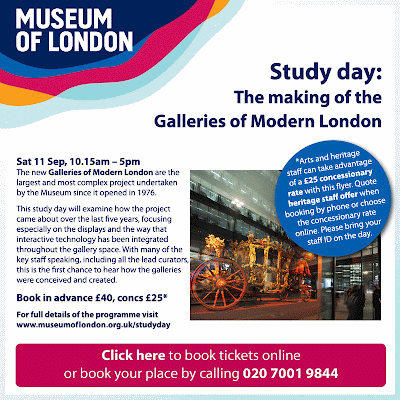
Museum of London's New Galleries
Monday, August 23, 2010
Image Collections and Paywalls
Museum Music
Saturday, August 21, 2010
Tina's Groove, by Rina Piccolo, August 21, 2010
Monday, August 16, 2010
Tales from the Road 2: Museum Mirroring
Saturday, August 14, 2010
Bridging Ages Conference 2010: How telling the past at historic sites benefits society (Sweden, 17-19 November 2010)
Kalmar, Sweden, 17-19 November 2010
Contemporary society is in a process of transformation to adapt to new environmental, social and political challenges of global significance. We need to find new ways to address ever larger issues. In this situation we wish to reconsider the role of cultural heritage. Since the 19th century, nation states have drawn on the national heritage in order to construct exclusive cultural identities based on the paradigm of shared roots.
As the world has been changing dramatically over t
The past two hundred years, we need to ask how cultural heritage and stories about the past benefit society today.
– Which historic sites and stories about the past are important in creating meaning for people today?
– How should the past be told and whose stories should we tell in multi-cultural societies?
– In what way can historic sites promote social cohesion, human rights, peace and democracy?
– What contribution is made by recalling traumatic memories of violence and oppression?
– Which new ways are emerging in which cultural heritage benefits society today?
The purpose of the conference is to generate discussion across a broad spectrum of possible answers to these and related questions. We will bring together researchers and professionals from a variety of academic disciplines and occupations in several countries. The conference will also feature a unique “Time Travel” experience applying a widely practiced method of historic environment education. The resulting dynamic of the conference will result in new ideas and provide practical inspiration for all participants.
Please send your paper proposal containing paper title, a few words about yourself and an abstract of approx 200 words (in English) no later than 15 August 2010 to cornelius.holtorf@lnu.se . You will hear by 6 September about acceptance of your paper.
The conference is jointly organised by Linnaeus University Kalmar-Växjö (www. lnu.se), Kalmar läns museum/Centre for Historic Environment Education and Bridging Ages,
International Organization in Historic Environment Education and Time Travels .
The conference is supported by the Swedish Science Council (Vetenskapsrådet).
Organization Committee: Birgitta E. Gustafsson and Cornelius Holtorf, Linnaeus University; Ebbe Westergren, Bridging Ages, Kalmar läns museum.
For further information contact and pre-registration (to ensure receipt of full program and registration form): Ebbe Westergren, ebbe.westergren@kalmarlansmuseum.se +46 (0)480 451345, +46 (0)70 6729406 or Birgitta E. Gustafsson, birgitta.e.gustafsson@lnu.se +46 70 5477953
http://www.archivalplatform.org/conferences/entry/bridging_ages_conference/
Wednesday, August 11, 2010
Tales from the Road: Museum Merch
CFP: New Zealand Tourism & Hospitality Research Conference, 2010
24 to 26 November 2010
Auckland, New Zealand
The conference theme “Adding Value Through Research” focuses on linking industry and academia through research related activities and aims to prompt involvement and engagement from both those who conduct and those who commission and use it. They seek papers and presentations which inform the wider tourism community regarding how research adds value. This conference will focus on celebrating and advancing research not for its own sake, but for the value it can bring to others.
See more here.
Monday, August 09, 2010
Deutsches Museum Scholarships
The Deutsches Museum in Munich has several attractive scholarships to offer research scholars interested in working for six or 12 months on projects involving the museum`s vast and heterogeneous collections. The scholarship programme is international and interdisciplinary in scope.
More here
Thursday, August 05, 2010
Federation of International Human Rights Museums
CFP: Museum Engagement and Applied Anthropology
Call for Papers: Society for Applied Anthropology Annual Meeting Seattle, Washington (March 30 – April 2, 2011)
Session Title: Museum Engagement and Applied Anthropology
Session Organizer: Robert P. Connolly (University of Memphis)
The session is conceptually framed around The Participatory Museum by Nina Simon and the contribution that applied anthropologists bring to the discussion. Simon (2010:ii-iii) defines a participatory institution as:
a place where visitors can create, share, and connect with each other around content. Create means that visitors contribute their own ideas, objects, and creative expression to the institution and to each other. Share means that people discuss, take home, remix, and redistribute both what they see and what they make during their visit. Connect means that visitors socialize with other people—staff and visitors—who share their particular interests. Around content means that visitors’ conversations and creations focus on the evidence, objects, and ideas most important to the institution in question.
The session aims to discuss participation in the building of sustained and engaged relationships and the methodological and theoretic contributions of applied anthropology to the process.
Relevant questions session papers may address include:
- As cultural institutions how can museums demonstrate their value and relevance in the 21stCentury?
- Can museums serve as “third places” for social engagement?
- What is the relevancy between shifting demographics and museum inclusivity in community engagement?
- How do theoretic orientations, such as the constructivist approach and free-choice learning inform on the Participatory Museum.
- How does the Participatory Museum influence the authority of voice in both content and function of cultural institutions?
- What can applied anthropologists add to the discussion of Participatory Museums?
- How can museums function as dynamic venues for sustained and engaged relationships with a diversity of communities.
Although papers are not required to remain within the parameters of Simon’s discourse, for reference, her book is available at:
http://www.participatorymuseum.org/
If you are interested in participating, please send a brief summary of your proposed contribution to Robert Connolly at rcnnolly@memphis.edu by September 1, or before.
Wednesday, August 04, 2010
Things That Go "BUMP!" In The Night
Oh, and while looking at this, I also found this...
I have to get out more.
GHost III - Call for Artist Films
We are inviting submissions of artist films on the theme of ‘Ghost hunters’. We welcome short films, but will consider films of up to 20 minutes in duration. Films should be suitable for screening as part of a show reel, rather than for installation. The works will be screened on a big screen in the nave of the church of St John Bethnal Green as part of “GHost III”, an annual weekend-long exhibition with performances and screenings.
We are interested in moving image works which explore the various angles and aspects of ghost-hunting.
Tuesday, August 03, 2010
The Folly Fellowship
Welcome to the home of the Folly Fellowship.
The Folly Fellowship was founded in 1988 as a pressure group to protect, preserve, and promote follies, grottoes & garden buildings. Initially a group of enthusiasts keen to record what was at first seen as a peculiarly British aspect of architecture, it has grown into a serious conservation and consultative architectural heritage charity, while not losing sight of the basic idea that these buildings are fun - they were built for pleasure before purpose. Some make us laugh, some provoke contemplative thoughts, some can frighten. Some are mere whims, others demand to be taken seriously.
People take their pleasures seriously - why should buildings be any different? An early realisation was the international flavour of the genre although the British Isles can count more follies per square mile than any other region, there are examples to be found all over the world.
In recent years, there has been an increased awareness of the importance of these buildings to our landscapes. Many have been restored and several have been completely rebuilt with local support. Better still, some individuals with imagination and the tenacity to fight the planning process, have begun to build new follies...
Irish Heritage Rights Survey Launch to Coincide with Tara UNESCO Nomination
http://www.tarawatch.org/